Last year, I wrote a post about whether Hermione (of Harry Potter) is white. In that post, I pointed out that people seem to need only flimsy evidence to assume someone matches the 'default' - e.g., white, male, able-bodied, cis, straight - but very strong evidence to assume someone is 'other.'
I thought of this recently because I did exactly that myself. That is, I assumed the status quo based on weak evidence and ignored strong evidence to the contrary. Someone I've known for a few months now is Jewish and it took several hints and outright asking for me to know that for sure.
I could say, "I didn't want to assume," but, of course, I was making an assumption either way. It's just which assumption. But, I knew he had a relative living in Israel ("but that could be because of the relative's partner!") and I knew his name was Jewish ("but it could come from the alternative French source!"). On the flipside, I knew he didn't keep kosher, or, rather, had quite strong evidence that he didn't (but many Jewish people aren't strict about that), and I think I've known him to use technology or otherwise not strictly observe the sabbath (but, ditto, and also I could just be misremembering). Also, he said "Merry Christmas," but, as he pointed out himself, he knows that Christmas exists, and I know I had previously mentioned in a group conversation that I'm (culturally) Catholic, though he may not remember that. Either way, I know that Hanukah and Passover (etc) exist and I'm not Jewish or even living in a predominantly Jewish society. I feel like I'm in a very small group because only 3% of the UK population tick the 'mixed-other' box like me, but even fewer people tick the box marked 'Jewish' - only 0.5%.
I haven't changed the opinion expressed in that post. People make assumptions. We should know we're doing it so we can correct it on the occasions when we get it wrong, instead of blindly or defensively arguing for whatever assumption we're making. In theory, I could be defensive and argue that I was right to assume the default, but why? Why would I do that? Just go, "Oh, interesting,", correct your mental notes/tags, and move on with your day. Or, if it's a fictional character, just go, "Oh, I guess you could see it that way," and then either decide to carry on picturing the character however you were before, or change, or flip back and forth, based on whatever suits you.
I think the first reason I wanted to share this because it's really easy to notice when other people are making errors in their thinking, but much harder to realise and acknowledge when you're doing it. The second reason is, Holocaust memorial day was yesterday, 27th January. That's the anniversary of liberation of Auschwitz-Birkenau, the largest Nazi death camp. This year's theme is 'Ordinary People.'
I didn't intend this when I started writing, but I think what I talked about above ties into that theme. Most people assume other people are probably like them, and that tomorrow will probably be a lot like today. It's okay to assume that - you'll get the right answer a lot of the time, and if you never, ever made any assumptions, you'd never get through the day. Plus, if you feel afraid or insecure, assuming other people don't feel like you is, in my experience, more likely to be wrong and cause you unhappiness than assuming many people will feel the same way. The trick is, again, you have to know you're making assumptions and be ready to pay attention and correct them if they're wrong.
The other thought-error we make about the Holocaust is, at least in British schools, to treat it as an anomaly, something that came from a unique evil or a unique time in history. To me, at least, the attitude is "Isn't what Germany did terrible? We must never, ever be like Germany!". Which isn't wrong exactly, since obviously the Holocaust was terrible and must never be repeated, but it does innocently gloss over terrible events the British Empire was involved in, like Partition, or basically everything Europe did in Africa or to African people. It also, somehow, ignores the part where the Allies didn't liberate everyone from Concentration camps, and even punished people like Alan Turing for being gay.
We get the impression that antisemitism was a thing that happened once, when the Holocaust was the culmination of a hatred that had been growing for thousands of years (I actually learned that from visiting museums in Hamburg, but I looked for a source I could share). Ordinary people think "it can't happen here" or "it was an aberration that won't happen again." I suspect a lot of ordinary people in the 1930s thought it couldn't happen there or then (link is about Martin Niemöller, who wrote the poem First They Came).
The links above have some suggestions for further reading. I haven't read much about the Holocaust, but I would recommend Maus, a graphic novel by the child of two holocaust survivors. I've never read The Diary of Anne Frank because, to be honest, I don't think I can handle it, but it's an obvious one to mention. She knew her diary might be published - based on a radio broadcast, which mentioned that the diaries of ordinary people were a good historical record - and began editing it during her lifetime. The diary was also edited by her father, the only surviving member of her family. One of the things that was removed - I think, by Anne herself - was the fact she was bisexual. On the one hand, I'm opposed to reading private diaries except when, like in the published version, the writer themselves intended it to be read. On the other hand, it's important to acknowledge all the victims of the Holocaust, including the LGBTQ community, and even though she would have been persecuted "just" for being Jewish, her bisexuality would also have been dangerous.
One of my favourite books is The Basic Eight by Daniel Handler, who is Jewish, though that's not what the book is about, apart from in the way a person's culture/viewpoint informs all creative work. The TV show Crazy-Ex-Girlfriend is similar, in that sense. It's not about being Jewish, it's about a specific person who is Jewish.
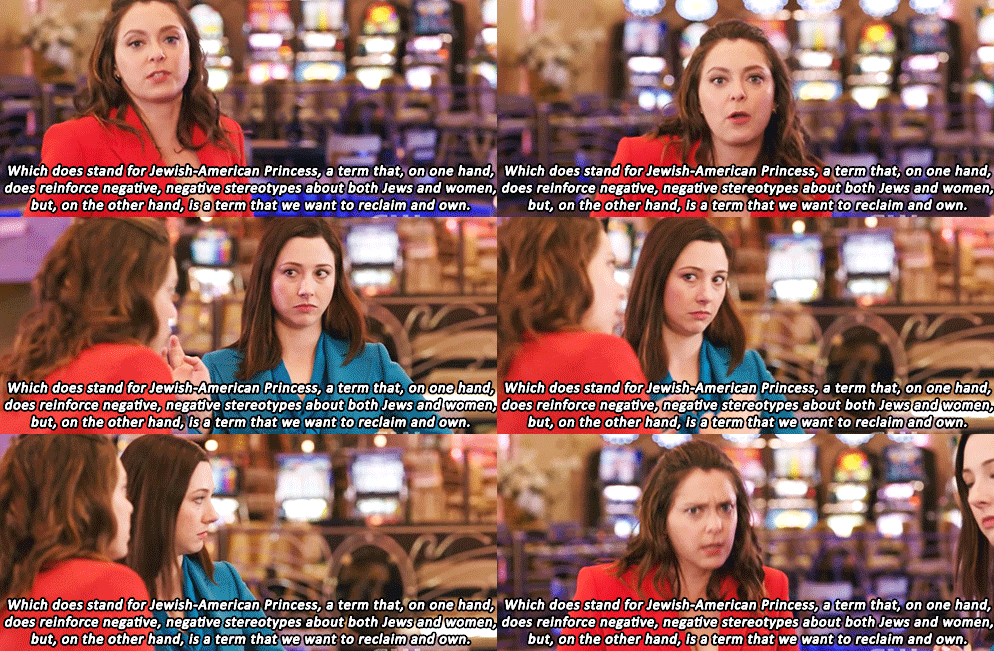 |
| An interlude in the song 'JAP Battle' |
Being Jewish, like being of any other group, is a category, which means the individuals within that category aren't identical. They have enough traits in common to be in the category, but exactly which traits and to what extent vary. The solution is to read (or watch, or talk to) a lot of different representative viewpoints, to get an idea of the overall picture. Like at football matches, when dozens of people hold up squares to create an image. For instance, I could hold up my square, for my experience of being mixed race or being neurodiverse, but mine only represents me. You need to look at a few more to get a feel for what the overall image is. It's the same for any other group humans might be part of.
In addition to the links above, I found the following while googling but didn't end up specifically referencing the content: Hey Alma; Forward; 1938 Projekt. I also learned that Kafka was Jewish and about an upcoming game called A Light in the Darkness which aims to educate people on the Holocaust. I found this article on celebrities you might not realise are Jewish or have Jewish heritage, such as Rashida Jones, Jack Black, Daniel Radcliffe, Winona Ryder, Maya Rudolph, and Zoe Kravitz. They all have different relationships with Judaism because of course they do. The article has a few links to where that's been further discussed, like Bob Saget being interviewed on the Jewish Federation of LA Podcast.

