Showing posts with label Harry Potter. Show all posts

Saturday, 28 January 2023

In Which We Discuss Assumptions and the Holocaust

Last year, I wrote a post about whether Hermione (of Harry Potter) is white. In that post, I pointed out that people seem to need only flimsy evidence to assume someone matches the 'default' - e.g., white, male, able-bodied, cis, straight - but very strong evidence to assume someone is 'other.'


I thought of this recently because I did exactly that myself. That is, I assumed the status quo based on weak evidence and ignored strong evidence to the contrary. Someone I've known for a few months now is Jewish and it took several hints and outright asking for me to know that for sure. 


I could say, "I didn't want to assume," but, of course, I was making an assumption either way. It's just which assumption. But, I knew he had a relative living in Israel ("but that could be because of the relative's partner!") and I knew his name was Jewish ("but it could come from the alternative French source!"). On the flipside, I knew he didn't keep kosher, or, rather, had quite strong evidence that he didn't (but many Jewish people aren't strict about that), and I think I've known him to use technology or otherwise not strictly observe the sabbath (but, ditto, and also I could just be misremembering). Also, he said "Merry Christmas," but, as he pointed out himself, he knows that Christmas exists, and I know I had previously mentioned in a group conversation that I'm (culturally) Catholic, though he may not remember that. Either way, I know that Hanukah and Passover (etc) exist and I'm not Jewish or even living in a predominantly Jewish society. I feel like I'm in a very small group because only 3% of the UK population tick the 'mixed-other' box like me, but even fewer people tick the box marked 'Jewish' -  only 0.5%.


I haven't changed the opinion expressed in that post. People make assumptions. We should know we're doing it so we can correct it on the occasions when we get it wrong, instead of blindly or defensively arguing for whatever assumption we're making. In theory, I could be defensive and argue that I was right to assume the default, but why? Why would I do that? Just go, "Oh, interesting,", correct your mental notes/tags, and move on with your day. Or, if it's a fictional character, just go, "Oh, I guess you could see it that way," and then either decide to carry on picturing the character however you were before, or change, or flip back and forth, based on whatever suits you.


I think the first reason I wanted to share this because it's really easy to notice when other people are making errors in their thinking, but much harder to realise and acknowledge when you're doing it. The second reason is, Holocaust memorial day was yesterday, 27th January. That's the anniversary of liberation of Auschwitz-Birkenau, the largest Nazi death camp. This year's theme is 'Ordinary People.'


I didn't intend this when I started writing, but I think what I talked about above ties into that theme. Most people assume other people are probably like them, and that tomorrow will probably be a lot like today. It's okay to assume that - you'll get the right answer a lot of the time, and if you never, ever made any assumptions, you'd never get through the day. Plus, if you feel afraid or insecure, assuming other people don't feel like you is, in my experience, more likely to be wrong and cause you unhappiness than assuming many people will feel the same way. The trick is, again, you have to know you're making assumptions and be ready to pay attention and correct them if they're wrong.


The other thought-error we make about the Holocaust is, at least in British schools, to treat it as an anomaly, something that came from a unique evil or a unique time in history. To me, at least, the attitude is "Isn't what Germany did terrible? We must never, ever be like Germany!". Which isn't wrong exactly, since obviously the Holocaust was terrible and must never be repeated, but it does innocently gloss over terrible events the British Empire was involved in, like Partition, or basically everything Europe did in Africa or to African people. It also, somehow, ignores the part where the Allies didn't liberate everyone from Concentration camps, and even punished people like Alan Turing for being gay. 


We get the impression that antisemitism was a thing that happened once, when the Holocaust was the culmination of a hatred that had been growing for thousands of years (I actually learned that from visiting museums in Hamburg, but I looked for a source I could share). Ordinary people think "it can't happen here" or "it was an aberration that won't happen again." I suspect a lot of ordinary people in the 1930s thought it couldn't happen there or then (link is about Martin Niemöller, who wrote the poem First They Came).


The links above have some suggestions for further reading. I haven't read much about the Holocaust, but I would recommend Maus, a graphic novel by the child of two holocaust survivors. I've never read The Diary of Anne Frank because, to be honest, I don't think I can handle it, but it's an obvious one to mention. She knew her diary might be published - based on a radio broadcast, which mentioned that the diaries of ordinary people were a good historical record - and began editing it during her lifetime. The diary was also edited by her father, the only surviving member of her family. One of the things that was removed - I think, by Anne herself - was the fact she was bisexual. On the one hand, I'm opposed to reading private diaries except when, like in the published version, the writer themselves intended it to be read. On the other hand, it's important to acknowledge all the victims of the Holocaust, including the LGBTQ community, and even though she would have been persecuted "just" for being Jewish, her bisexuality would also have been dangerous.


One of my favourite books is The Basic Eight by Daniel Handler, who is Jewish, though that's not what the book is about, apart from in the way a person's culture/viewpoint informs all creative work. The TV show Crazy-Ex-Girlfriend is similar, in that sense. It's not about being Jewish, it's about a specific person who is Jewish. 
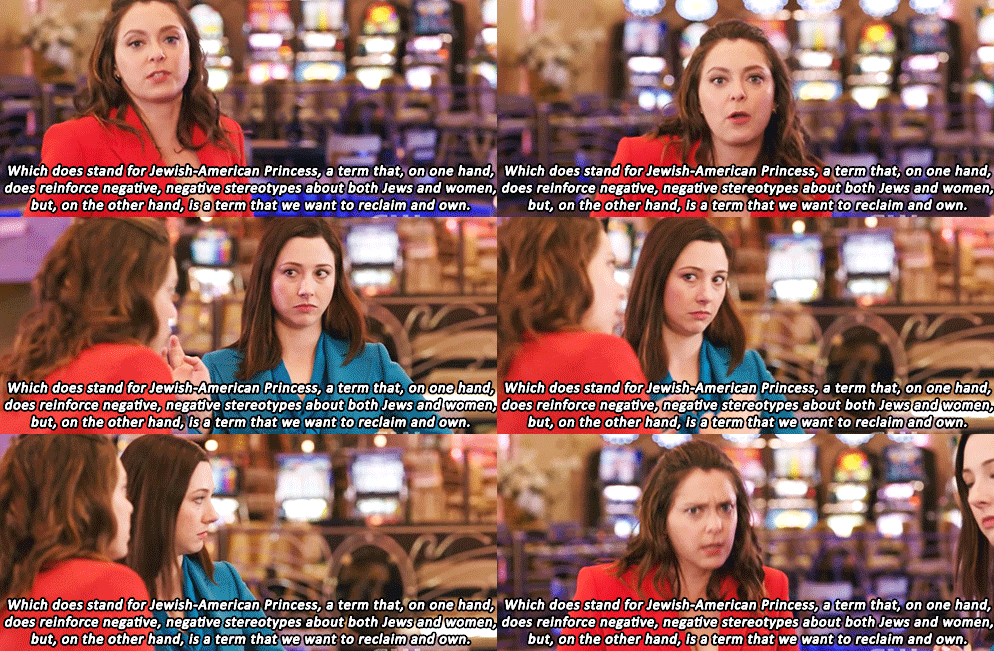

An interlude in the song 'JAP Battle'


Being Jewish, like being of any other group, is a category, which means the individuals within that category aren't identical. They have enough traits in common to be in the category, but exactly which traits and to what extent vary. The solution is to read (or watch, or talk to) a lot of different representative viewpoints, to get an idea of the overall picture. Like at football matches, when dozens of people hold up squares to create an image. For instance, I could hold up my square, for my experience of being mixed race or being neurodiverse, but mine only represents me. You need to look at a few more to get a feel for what the overall image is. It's the same for any other group humans might be part of.


In addition to the links above, I found the following while googling but didn't end up specifically referencing the content: Hey Alma; Forward; 1938 Projekt. I also learned that Kafka was Jewish and about an upcoming game called A Light in the Darkness which aims to educate people on the Holocaust. I found this article on celebrities you might not realise are Jewish or have Jewish heritage, such as Rashida Jones, Jack Black, Daniel Radcliffe, Winona Ryder, Maya Rudolph, and Zoe Kravitz. They all have different relationships with Judaism because of course they do. The article has a few links to where that's been further discussed, like Bob Saget being interviewed on the Jewish Federation of LA Podcast.

Friday, 4 March 2022

In Which We Discuss Whether Hermione is White

 I live in a society where the default is assumed to be white, male, cisgendered, heterosexual, able-bodied, and neurotypical. If you were to draw a stickman or mention the "hero" of a story, those are the traits that person has unless you specifically tell the audience that they aren't. This is why, for example, cartoons and costumes get things like eyelashes or bows added to them, to signify that they are women. In this society, people act like you need very, very weak evidence to assume a character matches that default and very, very strong evidence to think they are something 'other.'


Take Sherlock Holmes, for example. Personally, I think it's very clear that he is asexual. But, every adaption I've ever seen has treated him as straight, based purely on him admiring one single woman who appears in one story. Arguably, since he admires lots and lots of men, it would make more sense for him to be gay. But we don't imagine Sherlock Holmes as gay, because we would need something stronger to think that about him.


Similarly, take the Doctor, of Doctor Who. One of the earliest things that we learn about the doctor is that s/he is changeable. Their body changes. And yet, people argue that he is a man. Assuming he has some control over his regenerations, it does tell us something about him that he has repeatedly chosen white, male bodies, but that doesn't mean he must always choose white male bodies. If I got to have twelve different bodies - or twenty-four, or however many the Doctor gets now - I would definitely choose to be a man at least once, just to see what it was like. Why shouldn't the Doctor?


There's a concept called 'death of the author', that is, when you consider a work only based on what is in the work itself and totally ignoring the author as part of it. Alternatively, you can choose to include the author in how you interpret the work. Another way to think about that is to consider, when you ask "why did this happen?", are you asking Sir Arthur Conan Doyle or are you asking Dr John Watson? If you wanted to know "Why is Sherlock Holmes beating up a corpse when Dr Watson first meets him?" then Dr Watson would explain that Sherlock wanted to know what bruises looked like when they were caused after death. That's the Watsonian perspective. The Doylist perspective might be something more like "I wanted to show the reader the amount of research Holmes does, that he doesn't shy away from the gory elements, and that he is a strange man who cares more about the truth than about being polite."


So, when we ask, "is Hermione [of Harry Potter, not A Winter's Tale] white, are we asking JK Rowling or Hermione?". JK Rowling tweeted out her answer a while ago. 


[I should be totally clear here; Rowling is a TERF and has made multiple offensive tweets clearly stating her views, which are based on unfounded fears. I'm not saying or implying that her tweets are right or relevant to literally anything except the exact question of 'What does the author have to say on this element of her work?']

As far as Rowling is concerned, Hermione can be black. I suspect that Rowling intentionally avoided describing Hermione's race because it was totally irrelevant to the story. That's why she felt confidently able to say that "white skin was never specified."


And yet, some people have argued that, from a Watsonian perspective, Hermione is white. They base this on a quote about "Hermione's white face peering out from behind a tree." This is an example of what I was saying above, about people generally only needing very, very flimsy evidence to say a character matches the default, but strong evidence to say she is anything else. 


Let's think about the information being conveyed by that sentence. Do you seriously think that the middle of a dramatic scene, three books in, was when you would receive information about a character's race? You looked at that line and thought "yes, this is a good time to learn about Hermione's skin tone, that is very relevant information here"? Really? You're sticking with that? You're a fuckwit.


The sentence is there to tell you that Hermione is scared, that she is "white with fear." Guess what? I'm not white but I could go white with fear. Meghan Markle isn't white and she could go white with fear. Lots of non-white people are pale enough to go white with fear. And if you have any fucking doubt about whether Rowling was conveying information about race or emotion with that sentence, she outright told you. To think otherwise is to be wilfully ignorant.


This makes me very angry, because the context I see it brought up in is generally people of colour pointing out that it's totally fine to picture the character as looking like you/them, and then white people say "BUT YOU HAVE TO ACKNOWLEDGE THAT SHE ACTUALLY LOOKS LIKE ME."


No. Sit the fuck down. Shut the fuck up.


No one told you you weren't allowed to picture Hermione as white. No one even said you were wrong to do so. I'm pretty sure Rowling was picturing Hermione as white, even though she decided that wasn't important enough to mention. But you, seeing other people happy to imagine a character looking like them, couldn't bear that it wasn't about you and pulled the flimsiest, stupidest reasoning out of your arse to make it about you again. If you do that then, yes, you are being racist. That is why people call you that when you make that stupid argument. They call you a racist because you are being racist.


The alternative is that you genuinely think the author decided to randomly inform you of a character's race three books in, in a scene where it could not be less relevant, and then, when she told you she didn't, decided that actually...what? She's lying? She's mistaken? The "true wording" of Harry Potter exists objectively apart from her and she just wrote it down and didn't understand it properly? Rowling invented Hermione. If she says Hermione doesn't have to be white, you can't use her own words to claim that Hermione does have to be white. At best, that argument shows that she misspoke, that she did not make it clear enough to you that she wasn't randomly bringing up skin tone three books in. That argument does not mean that Hermione has to be white. Sit the fuck down. Shut the fuck up.


On a lighter note, guess what? If you want to picture Sherlock Holmes as a trans man, go ahead. I do not believe there is anything in the text to contradict that. We never hear anything about his chromosomes, hormone levels, genitals, he never impregnates anyone...It's unlikely that he would be trans, but it's not impossible. Dumbledore could also be a trans man or McGonagall could be a trans woman, based on the same reasoning. Reading is an entirely personal experience that happens between the reader and the page. If you don't like those interpretations, you don't have to like them. You can totally ignore them and carry on picturing those characters in your preferred way. You can even picture Dumbledore as straight, with a totally platonic brotherhood with Grindelwald if you want to. Like how the Russian commentator explained the 2018 Irish Eurovision entry. Point out that you can technically "go out" with someone platonically, or say "till death do us part" in circumstances other than a wedding. You're not technically wrong, but if you insisted everyone else had to agree with you, including the author, that would be as ridiculous as claiming that the only people who can go "white with fear" are white people. White people aren't literally white, you dribbling ham sandwich.


"Ah, such a beautiful platonic brotherhood"

- Russia, probably


If some people picture Holmes, or Dumbledore, or McGonagall as trans, that does not affect you or your experience of the books in any way at all. Sit the fuck down. Shut the fuck up.


If you want to point out that the authors did not intend those interpretations...so what? If Sir Arthur Conan Doyle cared about Sherlock Holmes' chromosomes, or genitals, or hormone levels, and he thought they were important to the story, he would have put them on the page. He didn't. He doesn't get to stand at my bedside every night telling me how he wants me to interpret each sentence, and nor do you. Well, he can, if that's really what he wants to do with his afterlife, but I can't see ghosts so I don't care. You can't do that, I'll call the police.


Note that, because of the 'strong evidence to assume non-default' thing, I don't think Rowling deserves much, if any, credit, for want of a better word, for writing a gay character in Dumbledore or a black character in Hermione. By not writing that on the page, by letting readers still picture those characters as the 'default', she's having her cake and eating it. That stage - of telling her readers "I saw this character as gay", or "it's cool if this character is black" - was a sadly necessary step, but we should be long past it now and able to freely show the audience that characters are non-default. It's not enough to just whisper, "Psst, weirdos, there's something for you too!" (google Queer-baiting, Race-baiting, etc for more on the subject). It's not good enough. Put it on the page, you coward.


NB, Rowling does get credit for writing a character with a amputation, because I can count on one hand the number of books I've read that portrayed that, and that one was actually on the page. That isn't to say or imply anything other than "hey, cool,  some people are amputees, it's weird more of them aren't openly portrayed in fiction."


Actually, if anyone wants to find a quote that proves, beyond a shadow of a doubt, Sherlock Holmes does not have a wooden leg (left, specifically) please let me know. Otherwise, feel free to picture him as an amputee as well. Or not. It's your reading experience. You can always call an exorcist if Conan Doyle doesn't like it.

Tuesday, 18 June 2019

In Which We Discuss War and Peace, Part 7, Chapters 11, 12, and 13

Chapter 11

The Melyukova household seems a little dull - they're busy dropping wax into the snow so they can look at the shadows the shapes will throw on the wall - until the mummers - disguised Rostovs & co - arrive and start dancing.  Natasha takes charge of getting the Melyukova girls' dressed in men's clothes, and then they join the party too.  After an hour or so of dancing and playing games, they get on to talking and telling scary stories.  Nikolai can't look away from this new, masculinely-confident Sonya.  When she goes off to stand in a dark barn by herself to listen for spirits, he chides himself for having been a complete eejit.  In the dark, with the stars and the snow shining, he runs off to a part of the path he knows Sonya will have to cross.


When Sonya arrives, Nikolai looks just as new and different to her, and they run into one another's arms.

Chapter 12


Natasha figures out what's up with Sonya and Nikolai, and arranges the ride home so they're riding together.  Nikolai spends the whole journey gazing at Sonya - even though he's driving - and vowing never to be apart from her again.  They're back to using thees and thous.  Halfway through the journey, Nikolai switches to Natasha's sleigh - by passing his reins to a coachman and running across to climb on the wing - and tells her that he's made up his mind about Sonya.  Natasha is pleased for them, and tells him to run back.  Nikolai notices the same bewitching newness in her disguised face - moustache drawn on - as he did in Sonya's.  This mix of male and female and the change between is another dichotomy, like War and Peace, which causes new revelations within the characters.


When they get home, Natasha and Sonya get changed - but leave the moustaches on - and sit and plan their future weddings and marriages, and how their husbands will be best friends, and so on.  Then they play a fortune-telling game, in which Natasha looks into a mirror by candlelight and tries to see her future husband.  She expects to see either a coffin or Andrew Bolkonski - which are the sort of things she's heard people talk about before - but doesn't manage to see anything except, as she jokes, "someone with a moustache" (herself).  She then gets Sonya to play, and whispers to Dunyasha, her servant, that of course Sonya will see something.  Sonya doesn't see anything, but, not wanting to disappoint Natasha, starts making things up.  She describes seeing Andrew lying down and 'something blue and red', which, despite being complete fiction, I predict will turn to be an actual prophecy, ala Ron Weasley being accidentally right about things all the time.

Chapter 13


Soon after Christmas, Nikolai announces his plans to his mother, who is not best pleased.  It was Darwin who did some experiments with self-crossing plants compared to non-inbred plants and first showed that inbreeding depression could be a problem, so we're well over a hundred years before the countess would be worrying about having two-headed grandchildren from Nikolai marrying his cousin (n.b. - that joke only works under the hopeful monsters theory of evolution, which is not true of our world, but must be true of the X-men and any other universe where genetic mutations leads to dramatic new powers and traits rather than, at best, small, slightly fortuitous changes, and, more often, to no visible change in phenotype or horrible death.  This note courtesy of my genetics degree).  The countess tries to tell the count calmly, but bursts into tears instead, prompting him to begun rebuking Nikolai.  Nikolai refuses to go back on his promise to Sonya (again).  The count is annoyed with Nikolai for not marrying an heiress and saving the family from ruin but is also aware of how he himself contributed to the state of the estate and so can't exactly tell Nikolai off for it, especially since, deep down, he does think Nikolai and Sonya are a good match.

Neither the count nor countess discuss it any further with Nikolai, but the countess does call Sonya to her rooms a few days later and tells her off for being a money-grubbing hussy (paraphrased).  Sonya would genuinely like to please the countess, but can't see how when she can't keep from loving Nikolai and Nikolai wouldn't be happy if she did.  When Nikolai hears of all this, he first seeks his mother's forgives, but, when it can't be won, threatens to elope.  The countess says that, like Andrew, Nikolai is old enough to marry without his parents consent, but she will never accept Sonya as her daughter.  


Natasha interrupts before either says something truly unforgivable, which, the narrations tells us, was about to happen.  Natasha manages to negotiate a truce.  The countess will leave Sonya alone, and Nikolai will not elope.  At the beginning of January, Nikolai returns to his regiment, resolves to retire as soon as he can so he can come back and marry Sonya.  With him gone, the whole household falls into a fit of depression, and the countess falls ill from "mental agitation".  They should be going to Moscow to sell the estate there, but they can't because of the countesses' illness.  Natasha isn't coping well with the continued prolongement of her engagement either.  She's annoyed that her best days are being wasted while Andrew is off doing interesting things and meeting new people.  Eventually, the count can't delay selling the estate any longer, especially not with Natasha's wedding trousseau (collections of linens etc needed to being married life) to be ordered.  Plus, Andrew is expected to be in Moscow for the winter, and Natasha is sure he's already arrived.  So, the count, Natasha, and Sonya set off for Moscow, leaving the countess behind.  

And that's the end of part 7!  I'm still on track to finish before my 31st birthday if read an average of 4 chapters per day.

Wednesday, 24 August 2016

In Which We Discuss Books I Read in my 28th Year, Week 1/52


10 books last week!  Well, slightly over a week; the 11th to the 19th of August.  This was a leap year, so my birthday was on the Friday not the Thursday.

Six rereads.  I'm reading (listening) to the City Watch books of the Discworld series in order, starting with Night Watch which adds a sad poignancy to the first few.  Poor young Sam.  It's interesting to observe that Sam is a man made by Keel, Carrot, and Vetinari, and then, ultimately, by himself.

How to be Good is one of my favourite of Nick Hornby's novels.  For a man who writes in a genre known as "lad lit" he writes excellent women.  Which kind of indicates that the people who try to gender genres are idiots.  I've also listened to The Upside of Rationality before; it's one of the first audiobooks I ever owned.

I started listening to Yes Please the other day when I walked the Birmingham-Worcester canal, from Birmingham to Worcester.  30 miles.  I also listened to Guards Guards during this trip.  The wisest line in the whole book is "your divorce will be like your marriage".  I've never been married or divorced, but that's certainly true in my experience.

The Silkworm is the second in the Cormoran Strike series.  I got it for Christmas and only just got around to finishing it.  I'm trying to get books off my unread pile before I move so I don't have to carry the bloody things!

The Wonderful Story of Henry Sugar is my favourite of Roald Dahl's works, with some competition from Danny the Champion of the World.  I did notice some interesting similarities with The Great Gatsby.  Henry Sugar is like the Benjamin Button version of Jay Gatz; a playboy who finds a goal, devotes all his time an energy to it, and finds he's a better person with a meaningful existence.  As opposed to starting as poor and ambitious, finding a goal, devoting all your time and energy to it, and becoming a playboy.

Unseemly Science is the second i the Gas Lit Empire series.  I'm re-listening to them all, eventually.

I read Cursed Child in the first hour of my birthday.  Cried five times!

Little Sisters of Eluria has a slightly longer post to come.

Finally, Men Explain Things to Me.  Very short, took about an hour and a half to read.  For my feminist bookclub; definitely good for bringing righteous feminist anger.  The next book is Atlas Shrugged, which I really look forward to discussing!

Thursday, 3 March 2016

In Which We Discuss Books I Read in my 27th Year, Week 29/52


Seven books last week!  That's 25th February to the 2nd March.  Bluebeard's Egg and Breakfast at Tiffany's are both library books.  I didn't enjoy Breakfast at Tiffany's because I didn't like Holly Golightly.  She's an annoying little twit and quite self-centred.  Bluebeard's Egg had some interesting stories but like most of Atwood's stories they didn't have a lot of plot.  I like plot.  Plot is awesome.  I enjoy books with plot.  You can do many excellent things without a lot of plot, such as examining situations and thinking about them.  But I quite like when things actually happen.

The Seventh Pan Book of Horror Stories did have plots.  Most of the stories were pretty Victorian, as it was published in the sixties and included a lot of Victorian work.  I found there wasn't a lot of build-up; most of the stories simply explained the horror and that was the end of it.

I did enjoy the short story by Harry Harrison in the collection, moreso than The Stainless Steel Rat.  It was okay, just not the sort of thing I normally go for; a cyberpunk piracy and conman story.

Memoirs of a Geisha is a book I've returned to over and over in the past decade.  This was the first time I'd listened to the audiobook, which I enjoyed once I'd gotten used to the voice.  I like listening to books on 3x speed; it makes longer books much more accessible.  Which is how I finished the Harry Potter series, though it did make me cry on the bus.

In Which We Discuss Books I Read in my 27th Year, Week 28/52


Ten books last week - 18th February to 24th February.

It's actually only seven books; Day of the Dead, Seven Deadly Sins, and Being an Account of the Life and Death of the Emperor Heliogabolus were all books I read a few weeks ago but didn't date for some reason.

I listened to the fourth and fifth Harry Potter books this week.  I thought I'd read the fifth book before, but now I come to listen to it I don't think I can have.  I definitely read Goblet of Fire back when it first came out.  They've very enjoyable.  I'm reading along with the essays on hpcompanion.

Haunted Heart is an biography of Stephen King.  I rather enjoyed it.  The book goes into the way that Stephen King tries to write away his fears.  It's a kind of superstition; if he writes about it it won't happen.  Which explains a lot.  Speaking of Stephen King The Dark: Tower: The Gunslinger is a graphic novel of part of The Gunslinger.  I'd forgotten half of the plot - mostly because I wasn't paying attention - so it was a nice refresher.

I liked The Psychopath Test better than So You've Been Publicly Shamed, I suspect because Jon Ronson didn't read it to me.  He's a much better writer than he is a reader.

I read Big Fish because I loved the film.  The book wasn't as good.  Less clear and fantastical, and more subtle in a way that was less interesting.

I didn't enjoy The Great Unexpected that much either; Sharon Creech's books are always a bit hit or miss for me.

Finally, Goblet of Fire and The Order of the Phoenix.  I'd read Goblet before and I thought I'd read Phoenix but now I've listened to it I don't think I can have.

Wednesday, 17 February 2016

In Which We Discuss Books I Read in my 27th Year, Week 27/52

Eight books last week!  That's 10th February to 17th February.

I finished the Matched series.  I've owned the first one for years - first read it in 2012 - so I borrowed the two sequels from the library.  It wasn't mind-blowing, but it was fun and nice to finally get some closure.  You can probably read something into the fact that I didn't read the sequels back when I first read the first book.


I also finished the Gas Lit Empire series this week, with The Custodian of Marvels.  My reaction is about the same as to the Matched series, though I did get through it a lot faster.  Part of that is because it's harder to find good audiobooks I can listen to on 3x speed so when I find a series with the right level of listenability I tend to go for it.

I also finished the Spilling CID series, although there's no indication that this book is the end of the series.  A very meta book, The Narrow Bed.   

Spoilers to follow! 

The killer has decided to murder everyone who gave an unwanted ereader to someone else and to kill the recipients who politely accepted the ereaders and shoved them in a drawer.  I'm kind of glad I listened to it as an audiobook and kept the fuck out of that mess.  There's also a straw feminist character, which is almost as bad as Hannah deciding Andrew Wakefield was being picked on.  No other character - not even Charlie who lives an exceptionally feminist life - says anything to the tune of "I'm a feminist but she's a tad overboard".  We just have one crazy feminist as our only example.  

Not one of her stronger efforts, in many ways.

End Spoilers.

The Broken was another audiobook.  It focused on two couples - with dreadful, ugly, London accents - one of whom breaks up.  It kind of fails at being mysterious and intriguing, though it does try.  The final twist was excellent, but there wasn't a lot of build up to it and it wasn't an exciting journey.

Finally, I listened to the first three Harry Potter books.  I originally read The Chamber of Secrets when I was ten or eleven, closely followed by Philosopher's Stone, Prisoner of Azkaban and The Goblet of Fire.

I kind of lost interest at that point.  It's hard to pinpoint why.  Some of it was to do with having a crush on Ron and then having very confused feelings about Hermione, whom I otherwise liked.  I was also put off by Rupert Grinch who looked nothing like I imagined the character.

I think there was an element of backlash as well.  With so many people raving about the series I didn't feel able to join in.  While I can't criticise the books themselves, my enjoyment of them kind of soured.

Now it's been fifteen years and I'm getting some of my affection for the series back.  It helps that I'm listening on Audible which makes it go by a lot faster; the entire series on 3x speed is less than 45 hours.

Wednesday, 24 September 2014

In Which We Discuss Eating Animals You Can Talk To

There are quite a few stories out there with characters who can speak to animals, but very few then go to deal with the dilemma of eating them.  Off the top of my head, I can think of three.

Eliezer Yudkowsky's Harry Potter and the Methods of Rationality is an excellent, novel-length Harry Potter fanfic which imagines that Lily was kind to Petunia, and as a direct result, Petunia married a scientist and was more loving towards Harry.  Harry Potter-Evans-Verres is a scientifically-minded rationalist who does lots and lots of interesting things at Hogwarts, and I very highly recommend giving it a read.  However, what we are concerned with here is what he does when he finds out about Parselmouth, and hears of other spells that can give animals cognisance.  He diligently researches exactly which foods are likely to have come from sentient creatures and avoids those he isn't sure of.

In Jinian Footseer, Jinian, who can talk to animals, doesn't eat anything explicitly mentioned as not being vegetarian in the first book.  In the second and third, she does explicitly eat meat.

In The Fairy Godmother, part of Mercedes Lackey's 500 Kingdoms series, Elaina drinks dragon blood and begins to understand all animal speech.  After listening to the chickens for five minutes she decides it's okay to eat them because they're stupid.

Sunday, 30 March 2014

Darker than your Wonderland, Chapters 7-9

Part 2 is here.

7. Promises

"I apologise for my father's behaviour," said Scorpius, as soon as they were outside. Rose gaped.

"Your father? I'm sorry about my father. He's not normally -"


"He's just very formal, he didn't mean - "


They stopped, and smiled at each other. Rose was relieved to see Scorpius' face thaw.


"Let's go get ice creams," she said, feeling more cheerful.

"Rose?" asked Scorpius, as they walked.

"Yes?"

"Could we – could we go to muggle London, one day?"

Rose looked at her friend's face. Unusually, for him, there was a slight flush along his cheekbones. She realised that he was asking a lot from her.

Rose wondered what Scorpius' father would think of his desire to explore a muggle city. He'd been allowed to keep the books, but she knew that he'd never been able to buy his own. It had probably never occurred to Draco that Scorpius would want more books. Even if it had, would Draco know how to get around the muggle world well enough to buy more? Rose knew her own father would struggle with that.


Rose realised it had cost Scorpius a lot to admit, even as subtly as he had, that this was something his father couldn't give him.

Wizarding fiction was nowhere near as broad as muggle fiction and the books that did exist didn't often cover fantasy or science fiction. There were myths and legends, and there were books about wizards losing their powers for whatever reason, but there were very few about worlds where magic worked differently, or where technology was fantastic and advanced. It was simply not a subject that many wizards were concerned with.

"Of course we can," she replied, vowing to make it happen somehow. Her muggle grandparents would be fine with her bringing a friend to stay with them, she thought, although they might raise eyebrows about it being a male friend. The main problem would be persuading her parents, but she was sure they'd come around.

Scorpius and Rose got so caught up in debating the works of Philip K. Dick that they were almost ten minutes late getting back to the Hogs Head. Draco Malfoy was waiting outside. As soon as Scorpius realised that, he stopped running, flattening his hair, and smoothing out his clothing.

"Father," he said, in greeting., his face still flushed from their hurry Draco nodded, and stepped forward, placing an arm around his son, guiding him away.

"Good day, Miss Weasley," he said as they passed.

Rose hurried into the Hogs Head, to find her dad sitting at the same table they'd left him at, with rather more empty glasses in front of him than before.

"Rose Perdita Weasley," her father said. "I think we need to have a talk with your mother."

Rose gulped.

8. Flash Git

"Hermione!" Ron called, as soon as they got into the house. Her mother looked up. "You'll never guess who Rose's new friend is!"

Reading her husband's mood, Hermione looked at Hugo. "Hugo, you want to go play with Lily?"

Hugo looked torn between seeing his favourite cousin and missing whatever was about to happen. His mother gave him a firm look, and he made up his mind.

Ron handed him some floo powder, and Hugo stepped over to the fireplace. "Remember not to go too far, son," Ron cautioned. Hugo nodded and was gone.

"What's this about Rose's new friend?" asked Hermione.

"Go on Rose, tell your mother who your new friend is."

"I already told you mum. He's a really smart boy, who likes muggle books. He's in Ravenclaw with me, and he's really good at charms, but I'm better at transfiguration."

"Tell her his name, Rose."

"Is that more important?"

"Rose!" Ron shook his head. "It's Scorpius Malfoy, 'mione! That flash, albino, git's son!"

Hermione looked between her daughter and her husband.

"Rose," she said, finally. "Take some floo powder, and go and see Uncle Harry and Aunt Ginny. I need to talk to your father."

9. The Pioneer Plaque

Her father didn't mention Scorpius again, and Rose didn't dare ask if they she could meet up with him. They exchanged owls frequently, and they were both glad to see one each other again when they got back to Hogwarts.

They didn't talk about what they'd been up to over the summer. Instead, they talked about the books they'd read. Rose explained some of the things that weren't immediately apparent to someone of a purely wizarding background. Scorpius was amazed to find out that man actually had walked on the moon. More than amazed.

He'd read books about space travel, of course, but he'd always assumed that that part was entirely fictitious. He hadn't realised that the reason for the explosion of space-based sci-fi in the 50s and 60s was due to man walking on the moon.

Rose felt quite amazed herself, as she described what she could remember of the space program. But, you couldn't keep up that level of amazement for long, and they soon found themselves talking about the upcoming year instead.

Part 4 is here.

Tuesday, 11 March 2014

Darker than your Wonderland, Chapters 4-6


4.  Reactions

It was two days before Rose received a reply.  She didn’t share it with Scorpius; he didn’t share his with her.

Later that day, Scorpius and Rose wandered out to the grounds of Hogwarts, both clutching piles of books.  Along with the reply from her father, Rose had received a package from her mother.  It was full of books she'd left at home.  She’d regretted that, now that she had Scorpus to share them with, and had pleaded with Hermione to send them.

It was a crisp autumn day and it didn't take them long to find somewhere to sit and read, away from prying eyes.  They leaned against a tree and quickly lost themselves and each other in the sheer joy of the stories.

After a while, Scorpius put his book down, and looked up at the sky.

"Father loves me," he said, apropos of nothing.  Rose stayed silent but lowered her book in order to gaze at him.
Scorpius scratched at the back of his neck, nervously. "He asked if it was something he'd done. If he'd turned me away from ambition. He said that, although ambition can be a bad thing, like it sometimes was for him, it didn't have to be.  He said he hoped this didn't mean I was turning away from my future."

Rose didn't know what to say.

"He's so disappointed," Scorpius continued, quietly. "I don't know how to tell him that he shouldn't be."

"My parents don't understand either," Rose confessed. "My mother was intelligent too, but she was put into Gryffindor. They're glad that I inherited that, but, I think…I think they wonder what I'm missing. Why I'm not brave."

5. Comrades

Gradually their parents came to accept that their children's paths differed from their own, and Scorpius and Rose began to feel a lot better about the letters they were receiving.

As far as they both knew, their parents were still unaware of their friendship.  Scorpius didn't have any other close relatives at the school to tell his father and Rose knew that her cousins hadn't said anything.   Rose had told her parents about a new friend – her best friend if she were honest – but she’d avoided mentioning any names.

Rose hated saying goodbye to Scorpius at Christmas. She loved her family, but there was nowhere she could just sit and read quietly at home.  They’d always want her attention, to go and play or to help with something.  And there was no one with whom she could talk about books like she did with him.

Scorpius had given her a list of books he'd like to borrow "if it's not too much trouble," and she'd promised to see how many she could fit into her trunk.

Despite all the fun she had with her family, it was a long winter break.  When she came back after Christmas, she headed to their usual table in the common room, pleased to see him already there.

"Good Christmas, Scorpius?" she asked.  He nodded, flashing a quick smile.

As they'd both settled in at Hogwarts, they'd moved away from their initial, shy, mannerisms.  Scorpius had cultivated his cool expression, and, in class, preferred not to volunteer to answer questions.  Often he didn’t seem to be paying attention at all, and it was only his near perfect marks that betrayed him.  In contrast, Rose was eager to answer questions first.

Scorpius’ face had seemed stern and haughty once but Rose had come to realise that that was just his natural expression.  Part inherited, part cultivated to get people to leave him alone.  Rose and Scorpius tended to work together, and this had ceased to draw comment from their classmates very rapidly.  In many ways, they made up for one another's weaknesses.  Rose was good at Transfiguration, while Scorpius showed an early talent for Charms.

6. Papa Wolf

The summer holidays promised to be even longer than Christmas had seemed.  Rose missed Scorpius.  Eventually they agreed to meet in Hogsmeade, one day in July.  Rose asked her father to take her.  She had yet to divulge exactly who her new friend was, so her dad had almost choked on his butterbeer when she waved at Scorpius Malfoy.  Draco Malfoy had not reacted so strongly, merely raising his eyebrows until they almost disappeared into his hair.

"So," he'd said, as they drew close to the table. "This is your new friend, Scorpius."

Rose held out a hand, eager to make a good impression. "Pleased to meet you, Mr Malfoy."

After a glance at Ron, Draco shook Rose’s hand. Scorpius glanced between them. At the start of the year, he and Rose had been of much the same height but now she was an inch or two taller than he was.

"I didn't lie, father," Scorpius said, so quietly that Rose thought that he probably didn't realise she could hear him. "She does come from a pureblood family."

Draco glanced at his son, but didn't reply. Rose's father had finished coughing and greeted Draco curtly.  “Malfoy.”

"Weasley."

"I wasn't aware that your son was my Rose's new friend." Ron finished, with a glance at his daughter.

"Quite." Draco nodded, and then turned to his son. "Scorpius Hyperion Malfoy, I will see you back here in two hours."

"Father -"

Draco held up a hand. "Not a moment longer. Do I make myself clear?"

Scorpius stopped. "Yes father."

Rose, Ron, and Scorpius watched as Malfoy stalked out of the pub, his coat swirling behind him.

Rose had seen a great resemblance to Scorpius in Draco. The hair, eyes, and general features, for a start.  And the cold, brusqueness...that was something she knew Scorpius adopted amongst people he didn't know well, as part of his shyness.  It was a defence mechanism.  She wondered what Draco's reason was.

"Flash git," said Ron, and Rose watched as Scorpius' face closed up. He turned to her father.

"I'm honoured to meet you, Mr Weasley," he said, smoothly, his face utterly blank. Rose wished her father had been friendlier.

Ron and Scorpius shook hands, and then Ron turned to Rose.

"I guess I'll see you here in two hours, too," he said. "Don't wander too far."

Rose nodded, and she and Scorpius left. Rose felt the coins in her pocket, and wondered if she had enough for ice creams.

Sunday, 9 March 2014

Darker than your Wonderland, Chapters 1-3

Here's a Harry Potter fanfic.  I wrote it in 2011, but I'm now working on editing it.

I'm not the world's biggest Harry Potter fan - in fact, I haven't even read all of the books.  But something about Scorpius and Rose fascinates me, and I'm particularly proud of this story, in which they bond over books.  All of the books mentioned are real, and the descriptions are accurate, if biased towards what they want or need to see in them at any given time.  It has twenty-seven chapters, but I'll post them in batches of three.  You'll be able to find the others through the tags, or you can read the original, unedited, version here.


Darker Than Your Wonderland

1.      In Common
When Rose looked back, it was her first day of Hogwarts that stood out as the moment her life took a different direction.  That was the day she wasn't sorted into Gryffindor, against all expectations but her own.

She’d intended to think Gryffindor, to want Gryffindor with all her might, but when it came right down to it she just couldn’t make herself do it.  Rose had read everything she could about Hogwarts, ever since her mother had taught her how to read.  Despite all the family stories, she knew she was more of a Ravenclaw than a Gryffindor.  She’d managed to keep that a secret right up until the hat shouted it out to everyone.

It had helped that just a few minutes before she'd watched her cousin Al being sorted into Slytherin, and Scorpius Malfoy being sorted into Ravenclaw. She knew she wouldn't be alone in disappointing her parents.

In the common room after the feast, she’d sat down intending to write a letter home.  He'd sat down next to her, returning her shy smile.

Come to think of it, maybe her life had changed earlier that morning - on the train.

2.      Understanding
Rose had lost Al only after a few minutes afterembarking.  She assumed that he’d gone off with his brother and Rose's other cousin, James.

Rose pictured herself walking through the train, asking everyone if they’d seen her cousins. She decided she really wasn't in the mood to be that social. Instead, she sat down in the empty carriage, and pulled a book out of her pocket.  Al would find her if he needed her.

The door opened, and the boy she'd noticed earlier poked his head round.  Scorpius, she recalled, the boy her father had warned her against.  Rose examined his face; the blond hair, and the cheekbones which already looked finely sculpted, even at eleven.  His expression seemed haughty, but when his eyes met hers, he flushed pink.  He looked like he might say something, but, instead, dropped his eyes and made his way to the seat opposite without looking at her again.

Rose felt embarrassed, too. She never quite knew what to say to strangers.

He took a book from his pocket, a battered paperback.  Rose couldn't help but try to read the cover.  She made out the author’s name, Jack Williamson, but she couldn't see the title.  She gave up and went back to reading her own book.

After an hour or so, Rose looked up, and met Scorpius' eyes. She smiled shyly, feeling awkward again.

"What are you reading?" He asked. Silently, she held up her book, so he could read the cover.  He did the same with his.

Alice in Wonderland. Darker than You Think.

Rose felt her pale skin flush again, and felt an irrational hatred towards her father's genes. Stupid pale skin!  She felt embarrassed over her choice of book; Alice in Wonderland seemed so babyish!

Scorpius’ didn’t seem to notice her blush; he asked for a closer look at her book, so they swapped.

Rose had never read Darker Than You Think.  It was a muggle book, as far as she could tell, and although Rose had often been exposed to her grandparent's library, it was one she'd never come across.

"This is a muggle book?" Scorpio asked. She looked up.

"Yes," she said. "It's a classic. Everyone's heard of it."

He looked down. Rose regretted her comment, as she realised he might have taken it as a criticism.

"Everyone in the muggle world," she added, hurriedly. "I wouldn't expect a wizard to know it."

He looked up then, his blue eyes vulnerable. She understood him then, in that moment. Like her, he hated to feel stupid about anything.

"I've never heard of this," she continued, holding his book up, offering her own ignorance as a gift. "Is it a muggle book, or a wizard book?"

"It's a muggle book," he confirmed. She'd suspected as much; it was science-fiction, as far as she could tell, and wizards went in for that even less than muggles did. "I found it in our attic."

Rose wondered why his family had had muggle books in their attic, until she opened the book, and saw the name written inside the front cover. Severus Snape.

Rose knew of the history of her family, and of the Malfoys, and of Severus Snape.  She guessed that Scorpius' father had inherited, or otherwise taken possession of, Snape's belongings.  She wondered why Draco Malfoy had never disposed of them, but she knew enough to realise she should avoid the subject. She handed the book back.

"Do you like it?"

His face lit up.  He explained the way magic worked in the book, so different from how their spells worked, how fascinating he found it.  She'd made him promise to lend it to her when he'd finished rereading it for what he told her was the seventh time.  Then she’d told him about Alice, and he’d extracted a similar promise from her.

They discovered that they both loved stories of magic, any kind, as long as it was different from what they'd grown up with. She'd told him about her beloved Three Hearts and Three Lions knowing he'd understand the appeal, something her family never had.  Her mother shared her love of reading, of course, but what her mother loved was books about real magic. Hermione had never quite understood why Rose liked fantasy and science fiction. Rose’s grandparents hadn't either, but they'd been happy to take her to muggle bookshops whenever she visited them.

Rose realised that what Scorpius loved about Darker was the same thing she loved about Three  and other books like it. Magic, in those books, worked scientifically, had an explanation she could understand logically.  Even though she knew that that wasn't how magic worked.

3.
Later in the common room, Rose was cursing her Weasley genes again. When Scorpius had sat down next to her, the whispers had started, and she’d blushed as red as her hair. She was undeniably a Weasley – red hair, freckles – and he was undeniably a Malfoy, and every student in the room knew the history of their families.

Scorpius had kept his eyes focused on the parchment in front of him. He hadn't gone red, but Rose knew his refusal to look up was a sign of his own embarrassment.

Apart from the stares, the Ravenclaw common room was heaven. Three of the four walls were covered with bookcases, with comfortable sofas and desks taking up space in the middle of the room.  Rose reached behind her, and took some books from the nearest shelf, stacking them in front of her and Scorpius.  He'd looked up when he realized what she was doing and smiled at her properly.

"Good idea," he said quietly. She smiled back, and gestured to her own sheet of parchment.

"I don't know how I'm going to tell them," she confessed.

"Your parents? Me either. The Malfoys have been Slytherins for generations -"

" – and the Weasley's have been in Gryffindor for even longer!"

They exchanged a wry smile, realizing that they were fast friends, already.

"That's what father says," Scorpius continued. "But I've looked at the family tree. Father's cousin, Nymphadora Tonks, was a Hufflepuff. And grandmother's cousin, Sirius Black, was a Gryffindor! It's about time we had a Ravenclaw in the family!"

Rose knew he was rehearsing. It wasn't her he was trying to convince, or himself. It was his father.

He'd know as well as she did that those arguments wouldn't work on the Draco Malfoy she'd heard about.  They were both Ravenclaws after all, he wasn’t a fool.  So either she didn't know Draco as well as she thought she did or Scorpius was unduly optimistic.  She'd guess the former; she'd only heard stories told by Draco’s enemies, and Scorpius had grown up with the man.

Rose filed that thought away for future reference, and looked down at her own parchment. Chewing her lip, she decided to go for the fast and brutal option.
Dear daddy,
I'm in Ravenclaw! I guess you were right about me inheriting mother's brains!
Love,
Rose
PS – did you hear that Al's in Slytherin?

There. She'd appealed to her father's affections, complimented her mother, and, if none of that worked, dropped Al in it too. Damage limited.


Sunday, 11 January 2009

In Which We Discuss Mary-Sue

Mary-Sue is a slang term used in fan-fiction and role-plays. It's when the writer, usually female, writes a version of herself into the story. Only, this self is incredibly beautiful, intelligent, good at everything, and a main character.


Every teenage girl (and possibly, boy) goes through that stage. I did, but fortunately, I was over it before I knew about the internet. It's great fun for the author, but quite annoying to everyone else, who does not identify with this fantastic, fantasy character.


I've said, in a previous post, that Harry Potter, Twilight, and Buffy the Vampire Slayer seem, to me, very Sue-ish. They are so successful because every teenager (and many adults) who read the books want to be the main character. They identify with them, and so, support them. And, as with any Mary-Sue, to anyone who does not identify with the main character, this habit is extremely annoying.


However, one adult book did manage to carry this off - Marianne Stilling's Damsel in this Dress. In many ways, it's an adult Mary-Sue, but, instead of being annoying, it succeeds in being hilarious. I don't know how she's done it, but it manages to be funny, reminiscent of my own mildly embarassing teenage fantasies, and highly enjoyable. Well done.

Friday, 21 November 2008

In Which We Discuss The Children's Section

Why do they hide all the good books here?

In my local library (Birmingham Central), the children's section is on an entirely different floor, with miniature chairs, decorations in pastel colours, and, once, palm trees made entirely of coloured balloons.

Now, the other day, I reserved a few books - namely, Bridge to Terabithia and Christopher Pike's Weekend. I noticed that, although I'd be picking them up from the main floor, the children's section had several copies of Pike's books. So, when I returned Bridge to Terabithia yesterday morning, I decided I'd return it to the children's section, then go ahead and explore their teenage shelves.

Honestly, it's amazing how nerve-wracking that was. I felt like an imposter. I'm twenty years old, and told that I look older. I felt like Gulliver walking into Lilliput.

Once I'd got over the initial embarassment, it wasn't so bad. The staff were friendly (it looks like they shift them between floors, so I'd seen a lot of them before), and none of the small children even looked at me. It also helped that an older man was in the queue in front of me.

I never made it to the teenage section, by the way. The Discworld Big Comic, Mort, grabbed me on the way past.

It's interesting how the books are segregated, by age. As I said, I found Mort in the children's section, and it was called a Big Comic. Neil Gaiman's Sandman series are upstairs, in the Graphic Novel section. Now, Gaiman is scarier than Pratchett, but they're not terribly different. And, in fairness, Death is one of the main characters in Mort.

A lot of children's books can be equally enjoyed by adults, too. While many are quite vapid, and assume that young = stupid, some are interesting. They're the kind of books you get more out of, every time you read them. Things like Peter Pan or The Little Prince, for instance. They're obviously children's books, but there's a lot in them for adults as well (honestly, if you've never read them, go take a look - you'll be pleasantly surprised).

The Discworld books and the Harry Potter series have both been given special 'mature' covers, so adults don't feel silly reading them. This is essentially the same as putting a different picture on the packaging for hair dye or moisturiser, so men don't feel silly using girly products.

Thursday, 13 November 2008

In Which We Discuss Harry Potter

I should probably say, right now, that I think the books are dumb.

I liked them when I was about eleven, I admit. But then I grew out of it. I became sick of the series long before it was over, which is a little sad, come to think of it. Still, I don't like those books.

I admit that part of it is because of the sheer amount of icky fan drool over every single copy. Much like FFVII, in fact. It's not a bad game, but the amount of people blathering on about how fantastic it is makes me want to be contrary.

And, of course...all of these people, who, to be honest, I don't think an awful lot of, are in love with this thing. Therefore, there must be something wrong with it.

I will admit that I am an inherently suspicious person.

There's also the gaping plot hole in the second/third book (there's no way to cure Lupin of being a werewolf, when Lockheart describes a spell that can do it in one of his books? I know that Lockheart didn't actually do those things, but he also admits that someone did. And even though the spell is described as difficult, since it's possible, Dumbledore would have found a way to cast it. He wouldn't do anything else). And the fact that JK Rowling cannot tell the difference between a witch and a wizard (it is NOT a gender issue - they use different kinds of magic).

The books just irritate me.

Saturday, 18 October 2008

In Which We Discuss Twilight and the Meaning of Love (as Regards to Books)

I have so many books I've been meaning to read recently. My problem is, I buy books in bulk, and then it takes a lot of effort to pick one to read. If I'm reading just one I'm not reading any of the others (ten points to anyone who knows which (Discworld) book I just ripped off a quote from). I've got piles and piles of brand new, shiny books all stacked in the cupboard, and there are some that I just never seem to get around to reading. I've had a pristine copy of Twilight sitting on the table next to me for the last several months, and I can never seem to find the time to open it.

Speaking of Twilight, from what I've heard (mostly, admittedly from people complaining about the fangirls) it sounds a bit like the ultimate original Sue (like Buffy). Just FYI, a Mary-Sue is a character invented to be just like the author, only perfect, and all kinds of cool things happen to her, and everyone loves her, and she's good at everything. Except, of course, in the case of Twilight, it's the readers who identify with the character and think like that. That's why I suspect it's so popular in the young adolescent age group. Bit like Harry Potter (grew out of it before the series ended :( ) or Buffy (never liked her, always preferred Cordy). And I'd just like to reiterate here that I've never even cracked the front cover open, so my judgement is, of course, completely biased and unfair. I'm sure I'll change my mind when I actually read it. Or perhaps not.

Speaking of cracking books open, I always do that. You can tell how well-read my books are from how worn the cracks in the spine are. My sister can read without doing that, and I've no idea how she does it. I just get too engrossed, and there it goes.

I think it makes them look loved. I think it adds character to a book that is in perfect condition, except for the signs of being read thoroughly and repeatedly.