Thursday, 20 August 2015
In Which We Discuss Books I Read in my 27th Year, Week 1/52
Three books this week, 12 August to 19 August; a library book, an audio book, and an old favourite. I used to have a physical copy, but now I own it on Kindle.
First, the audiobook; Around the World in Eighty Days. I recently read Michael Palin's real-life attempt to duplicate the feat, which prompted me to go back to the original.
This House is Haunted was a library book. It reminded me a lot of Henry James' Turn of the Screw.
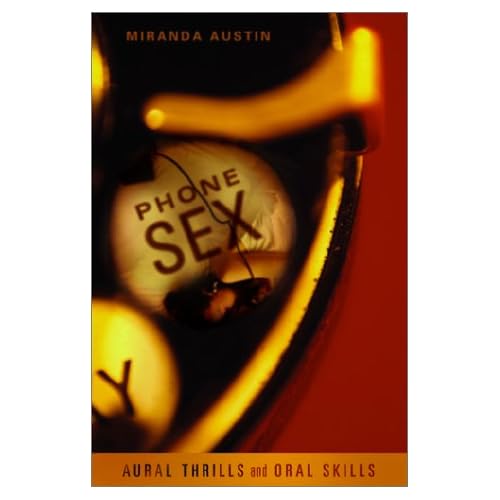
Finally, Phone Sex. This is the old favourite. I first read it as a teenager, several years ago and I've reread it every few years since. It's the memoir of a phone sex worker, with a few tips for people who want to try it at home, some info about the industry and lots and lots of stories about callers. All very fascinating.
I also enrolled in college this week, so I expect to be busier in future.
Monday, 29 March 2010
In Which We Discuss the Last Fortnight
Alright, I know what I wrote about trying to write something every week. What can I say? I haven't been in much of a blogging mood. Haven't been in much of a film/book mood either, as you can see if you check out my film blog, The Real Ratings.
Come to think of it, what have I been doing?
Anyway.
A metaphor from Nick Hornby's Polysyllabic Spree has stuck with me. Namely, that reading is a lot like eating. Sometimes, you're in the mood for something heavy - a big, three course meal, for instance. Or maybe something light, or something new, or something familiar, or something like fast food which you know isn't the best thing to eat, but which is trashily enjoyable anyway (Twilight, for instance).
Well, for the past few days or so, I've been leaning more towards familiar tastes. Comforting tastes. Things which are the literary equivalent of my scalloped potatoes recipe - personal, and familiar, and, to abandon the food metaphor, snuggly and worn, like comfy old slippers.
That's why I reread Helen Dunne's Light as a Feather. It's one of those chick-lit novels (I have a not-so-secret addiction to the damn things) that I picked up in a charity shop for about 50p, several years back.
Plotwise, it's not the most inventive thing ever. It's about a woman, Orla Kennedy, who decides to set up a diet chatroom/support group, to help her lose weight for her best friend's wedding. That information should help you classify the book slightly better - it's from the Irish side of the family, and it's about weight issues.
I don't mean that to sound derogatory, just informative. Generally speaking, Irish chick-lit (I intend to keep using that term; I don't find it derogatory or offensive, and the same goes for 'comic' rather than graphic novel) has a unique kind of style. That's not to say that every Irish writer writes like that, or that no writer of any other nationality can - it's just a trend I've noticed. And now I'm going to stop being so PC and just list a few examples; Marian Keyes, for instance, especially with things like Watermelon. Tina Reilly, although without dealing with the heavy issues that Is This Love? discusses. Like Cecilia Ahern, only nothing like so sad as PS - I Love You. In tone though, the book is mostly like Arabella Weir's Does My Bum Look Big in This?, only without so much harping on about self-hatred and Catholic guilt.
...all right, there is a bit of Catholic guilt.
While we're on the subject, American chick-lit is slightly different as well. For instance, the weight issues tend to be a bit more...well, more. I'm mostly thinking of Liza Palmer's Conversations With the Fat Girl, although, oddly, Jane Green's Jemima J has something of the same tone (incidentally, Green is English, with an America-sized ego. No, I did not accidentally leave off the 'n').
Anyway, my point is that in English or Irish chick-lit about weight issues, the women tend to be anything from a sixteen to an eighteen. In American novels, they tend to be rather larger than that.
That said, a lot of my English and Irish chick-lit was picked up in charity shops, and a lot of it dates from the early nineties. So perhaps it's more a sign of the times than of geography.
To contradict myself slightly on the craving-familiarity thing, I also read Jeremy de Quidt's The Toymaker the other day. It was a spur-of-the-moment choice in the library. They had all these glossy new paperbacks on a little shelf near the door, and that one looked interesting (as did Cliff McNish's Savannah Grey, although I haven't read that one yet).
The cover, for a start, was as creepy as hell. See that terrifying little doll? Shame she doesn't get more screentime, really.
Although the book dealt with some fairly mature themes (such as revenge, murder and organ-theft), you can still tell that it's a young adult novel. Part of that impression comes from the ilustrations throughout, but a lot of it is in the tone. There just seems to be something different about young adult novels, a lack of something to get your teeth into. And, oh look, we're back to the foor metaphor. And I've just realised I haven't eaten today.
Right, had a banana. Where was I?
The Toymaker. It's pretty interesting, and absorbing, but also downright creepy. It reminded me a lot of Philip Pullman's Clockwork. It's a book aimed at young adults, with all the blood left in, which is interesting if you're prepared for it (as you should be after looking at that cover).
Finally, at the moment, I'm rereading Miranda Austin's Phone Sex. I'm fairly sure I've mentioned that before. It's just so readable and fun.
It's essentially the memoirs of a phone-sex girl, mostly anecdotes, but with a few other things, all of it completely absorbing (and not just because it's about sex. I don't think, anyway).
I am starving. More later, maybe.
Wednesday, 30 December 2009
In Which We Discuss Sex
Let's start this post with a confession, just for a change.
When I was a little girl - about nine or ten - I thought being a prostitute didn't look like a bad career choice. Mostly, this was due to Pretty Woman. Sex and money, what could be bad about that? Of course, as I got older I learned a little more about it, and decided it wasn't for me. I'm not a girl who can separate sex and romance, or my homelife from my worklife, not to the extent required.
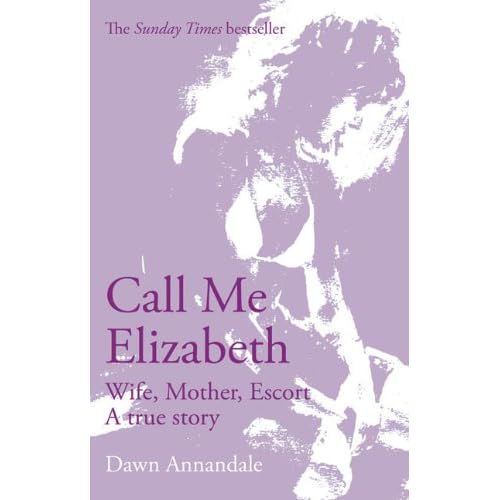
Still, I remain fascinated by the sex industry. A book I found very interesting was Dawn Annandale's Call Me Elizabeth, the true story of a woman who worked as an escort- (or call-) girl in order to fund the education of her six children. An articulate middle-class woman in her thirties, in many ways she didn't fit the typical idea of a prostitute - but, in another way she did. She'd been sexually abused by her father as a child, and although these events don't appear to directly influence her decision to sell her body, it seems telling that she saw fit to include this part of her history. Annandale had been away from her father for many years before she began work as a call girl, and it was in response to mounting debt, rather than, say, drug addiction or pressure from anyone else.
Another book about the sex industry which I found absolutely fascinating was Miranda Austin's Phone Sex, another set of memoirs. These are mostly anecdotes from Austin's time as a phone-sex operative, and make for a very interesting read. The book is absolutely laugh out loud hilarious, while still getting across the creepy feeling Austin got from certain clients. Austin actively enjoyed sex, and had always been told she had a sexy voice. She hadn't been abused, and nor was she on drugs.
Earlier, I bought a copy of Confessions of a Working Girl, by 'Miss S'. This one is the 'true story' of a prostitute who works in a brothel ('massage parlour', since brothels are illegal here in the UK), rather than on a street corner or going to client's homes, like a call girl. The blurb on the back cover reads as follows;
Miss S is smart, sassy, sexually frustrated and broke. With the rent money due, she spots an ad for a student job with a difference - in the massage parlour at the bottom of her road. Suddenly she can earn money doing something she is good at and get all the sex she needs.
Offered a job on the spot by Mrs B, an ex-working girl herself, Miss S quickly gets to grips with the rest of the girls. They include; Bella the house 'Domme', Carry the resident shrink, Tina the house snitch and Suzie the amateur porn star. That's not the mention the cast of clients; Mr Suck It Bitch, Mr Gay, Mr Pacemaker, Mr Councillor and Mr Willy Whacker...
Confessions of a Working Girl is the true, intimate diary of Miss S's extraordinary first year in a brothel and reveals exactly what a Gemini half hour really involves....
Honestly? My first thought at this point was "bollocks". Then I wondered why I thought that. I suspect it's because it sounds too happy. Do I honestly believe that every single prostitute in the world is unhappy, and dismiss entirely the idea that they aren't? I guess, instinctively, I do. And that can't be right, can it, to instantly disbelieve something just because it doesn't fit my preconceived stereotypes? After all, I can't exactly claim to have any intimate personal knowledge of the sex industry.
So, I started reading it. I'm now halfway through, and it turns out that while the blurb is complete bollocks, the book itself is really quite interesting. Most of those 'characters' only show up once, and the whole sexually frustrated thing is more understandable when explained in depth. Then there's the fact that although Miss S herself seems happy with her choice, and doesn't feel forced into it, or bad about herself, she does have some problems. Like condoms splitting, other girls on drugs, gossip, cattiness, and the paranoid idea that everyone around her knows what she's up to. Plus, it becomes clear after a while that she is the lucky one; she seems to be more of an anaomly than the majority. The other girls aren't middle class university students with high sex drives saving up for school supplies and their future - some of them are indeed on drugs, some have been kicked out by their families, some are single parents, and so on.
So, I guess what I'm saying is, my world view is restored. I don't know what that says about me. It's not that I want women in the sex industry to be unhappy - it's that I've always learned that the majority of them are. If they were all as happy and secure in their choice as Miss S, and if all brothels were as well kept as her workplace, it would become difficult to argue against the legislation of them. That would be a good thing, I think. Austin also seems happy and secure in her choice, but then, there's quite a distance between phone sex for money and physical sex for money.
To be honest, I still feel inclined to call shenanigans on the book, but the feeling subsides more as I get further through it.