Monday, 27 May 2019

In Which We Discuss War and Peace, Part 3, Chapter 17

Chapter 17


We're back to 9am, so presumably a little bit before Andrew gets shot (I am assuming he was shot).  Bagration doesn't want to march into battle, so he tells Dolgorukov, who's pushing for a commencement of the action, that he's going to ask the commander in chief (Kutuzov) for further instruction.  They're more than 6 miles apart, so even if the messenger is not killed (which Bagration is implied to be hoping for), and finds the chief, he won't be back before evening.  He sends Rostov.  Rostov is eager and acts what he should do if he meets His Majesty, the beloved Emperor, before the commander-in-chief, and Dolgorukov gives him permission to ask the emperor instead.

As Rostov rides towards Kutuzov, he begins to hear gunshots and to see bits of the battle through the fog, but not in enough detail to figure out what's happening.  He accidentally gets caught up in the Horse Guards, who are advancing to attack the French cavalry, but he manages to get free without being swept into battle. Rostov admires them and will he horrified later, when he learns that only 18 survived.  Suggested soundtrack below.


As Rostov rides by the Foot Guard, darling Bory calls out to him.  He's thrilled to have been in a real battle and survived.  He finally gets around to asking Rostov what he's up to, and there's some confusion over who Rostov is looking for before he's able to continue his quest.  Shortly after that, he hears gunshots behind the Russian troops, which surely can't be right.  It is though - he's in the middle of the same battle as Andrew, I think.  The Russians, Austrians, and Germans have turned against one another (like that's new, though maybe it was in the 1800s).  Rostov decides not to think about it, because surely none of this can be right, especially not the French soldiers near where he was told Kutuzov is.  He rides on.

Sunday, 26 May 2019

In Which We Discuss War and Peace, Part 3, Chapters 14 and 15

Chapter 14


It's 5am and the Russians are advancing.  They are feeling very optimistic about this, at least for the first hour.  Then they start to feel that something had gone wrong, especially since, as we know, the generals aren't particularly enamoured of the plan and so haven't bothered to go around cheering the men up about following it.  The narration says they blame the Germans, calling them 'sausage eaters'.  Really, they are the wurst.  Seriously though, I did not know that bit of slang went this far back.


No one is where they're supposed to be, and everyone is angry about it.  The narration informs us that the Austrian flank was moving to the left, which meant the centre was too far separated from the right flank, and so the Austrian cavalry had to turn around and come back, blocking the advance of the infantry.  So while they all think it's Germany's fault, it is actually Austria's fault.  I am not going to make a Hitler joke, it would be in poor taste.

An Austrian guide and a Russian general start fighting at the front, because the Russian wants his infantry regiment to get past without waiting for the cavalry, and the Austrian tells him its the fault of his higher command (it is).  None of this helps the troops' collective mood.
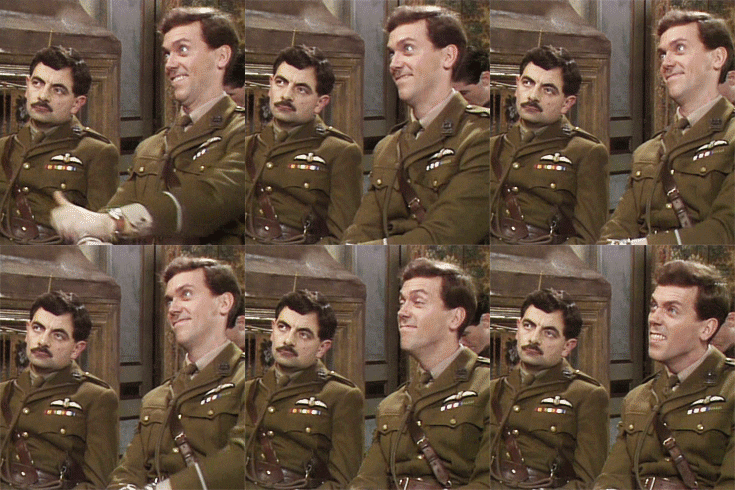

This whole thing takes an hour.  Then they finally make it down the hill and the first shots are fired.  Unfortunately, they'd expected the French to be further away, it's foggy, and none of the officers are telling them what to do (because they are also lost in the fog).  That's the first to the third columns.  The fourth column, including Kutuzov, are still on the hill.  I don't know where Nikolai is - presumably he's already down there, since he asked to be at the front.  Napoleon's standing on the opposite hill, gazing down at the sea of fog below which a battle is taking place.  His plan is going as intended - the Russian's think he's further away, in another direction.  He doesn't attack yet though - it's the anniversary of his coronation, and, watching the battle going his way, he has "the face of a boy happily in love".  You know, in another world, I think he and Nikolai would get together and paint little soldiers and map out amazing battles that take up entire flats.  Anyway, Napoleon tells his regiment to charge at the soldiers still on the hill.  It's just after 9am.

Chapter 15


We're back in time, at 8am.  Kutuzov is leading his fourth column down the hill.  Prince Andrew is behind him, and he's also feeling excited and optimistic.  I realise this is absolutely not the same thing, but the controlled calm suppressing excitement and irritation is how I go into exams.  Anyway, Prince Andrew feels that it's "the day of his Toulon, or his bridge of Arcola", which I looked up.

[1] On 17 November 1796, fighting the Austrians in northern Italy, Napoleon, at the head of his grenadier and with a banner in this hand, charged onto the bridge at Arcole to keep the enemy from taking it. The plague that was raging in Jaffa when the French stormed the city afflicted both the local population and the French army. Napoleon visited the plague victims in the hospital with his marshals Berthier and Bessières, an incident commemorated by the French painter Jean-Antoine Gros (1771-1835) in The Plague Victims of Jaffa (1804).

 So, in what Prince Andrew thinks is a moment of victory, he likens his feelings to that of a victory the enemy he's currently facing had won previously, in which everyone got plague.  This really does not feel like a good omen to me.

Prince Andrew is expecting difficulties when he finally joins the battle down in the foggy basin, and is daydreaming about how he's going to handle that, and how it will lead to his glory.  The fourth column finally reach the village and there's some difficulty in getting past it.  In response to someone turning up to ask if the fourth column has passed the village, Kutuzov sends Andrew to see if the third column has gotten past yet, and if they have sharpshooters.  They have, but do not - the head of that column doesn't realise he's anywhere near a battle, and, tbh, he may not be.  I'm beginning to suspect all the shots in the fog are just nervous Russians.  He gets back to Kutuzov, who is in no hurry to move forward.  The two emperors ride past, and Nikolai is going to be so mad he missed this.  The Tsar is not happy with Kutuzov - who he calls Michael Ilariovich - waiting, and tells them to get on with it, they're not on the Empress' field for parade.  Kutuzov replies that that's exactly why they're not moving yet - because it's not a parade.  Everyone is shocked that he would say such a thing to the Emperor, but Kutuzov has gone back to looking innocent and agrees he'll do what he's told.

Chapter 16


Kutuzov and his column stop after about half a mile, or five minutes.  The fog's clearer and they can see the enemy about a mile and a half away, on the opposite hill.  Then someone suddenly shouts and they realise there are more troops, less than five hundred paces away,  Prince Andrew decides this is his moment of glory and rides up to Kutuzov to tell him that the French must be stopped, but then the French start firing at them and people start screaming and running away.  Kutuzov doesn't run, even when someone tells him to, even when his face is wounded.  Prince Andrew forces his way back to him to check he's okay.  Andrew is less heroic and more scared now.  Kutuzov tries to get his men back, but is carried away by another column running away.  He finally gets through, with only four members of his suite (I am gathering, a smaller group within the column?), and rides towards the sound of gunshot.  Kutuzov tells them to get the column back, but gets shot at again.  This time, the French know he's a general and they're purposefully aiming for him and his suite.  The guy holding the flag gets shot, along with several others, and Kutuzov calls for Andrew.  Andrew jumps off his horse, grabs the standard and runs with a cry of 'Forward!', feeling pleased that people are shooting at him.  I can see how this would be a fun challenge and also how you'd be getting a massive jolt of adrenaline, but I also think he doesn't really believe that he can die.  Seeing how confidently he charges, the battalion come with me.  I did not have much faith in Andrew's dreams -


- but they seem to be working out for him.  A sergeant tries to grab the standard off Andrew, because Andrew can't really hold it up properly, but he immediately gets shot and Andrew runs on.


He makes it to the front, where he can see Russians running back towards him and French soldiers turning the guns around to fire back at them.  Still he keeps going, until he is very suddenly stopped, by some je ne sais quoi.  His legs stop working and he falls to the ground, he is unclear on why.  Presumably, he's been shot somewhere.  He's not dead - he's staring up at the sky and realising everything is vanity and falsehood except the infinity sky.  Not once in this whole thing has he thought about his wife and their future baby.

Saturday, 25 May 2019

In Which We Discuss War and Peace, Part 3, Chapter 13

Chapter 13


While Andrew Bolkonski is sitting through a war meeting, Nikolai Rostov is outside, on skirmishing duty, slowly drifting off while daydreaming about the Emperor.  He decides that, tomorrow, he'll ask to be on the front lines, so as to be closer to his hero.  Suddenly, he's woken by shouting, which he assumes is the enemy camp.  The hussar next to him - who is not named - is non-commital.   Prince Bagration and Prince Dolgorukov show up behind them, also trying to find out what the shouting is.  Since it's French cheering for L'Empereur, I suspect it is the enemy camp.  The generals order Rostov to go take a closer look.  Rostov gets shot at and comes back to find Dolgorukov insisting that the French are terrified and retreating and clearly only lit fires as a trick.


Rostov reports that the French haven't moved from where they last saw them, and manages to get in his request to be sent to the front, in the secret hopes that he'll be sent to the Emperor with a message.


Bagration agrees and asks if he's Ilya Rostov's son, which Nikolai ignores.  I am not sure whether he is or not, I can't remember if it's come up.

I googled, it has and he is.

We - the all-seeing audience and the narrative voice - then nip over to the French camp, where it turns out the shouting is because Napoleon is riding around while his proclamation is sent around the camp.  He's telling them that the Russians will attack tomorrow, that they've beaten them before, and how he intends to attack their flank as they march around on the right (I can't recall if that's actually their plan or not - I dozed off with Kutuzov when they were talking about it.  I suppose it's possible that the actual plan could be something so stupid that Napoleon would never foresee it).  He also refers to the Russian army as the 'hireling of England' (which may be accurate, we have had a lot of wars with France), and vows that he'll be out on the front lines if they ever appear to be at risk of losing, which he doubts will happen.  And there we end.  I suspect that the French will win, but we'll find out tomorrow I guess.

Friday, 24 May 2019

In Which We Discuss War and Peace, Part 3, Chapter 12

Chapter 12


At the meeting, Weyrother - who came up with the agreed-upon plan of attack - is excited.  Kutuzov is not.  Prince Bagration skips it entirely.  Prince Andrew comes to tell them and remains in the room, based on Kutuzov's previous implied invitation.  Kutuzov doesn't care - he falls asleep.  Weyrother's plan is so long and boring and complicated that the narration wraps it up with "and so on".  It takes an hour.  Langeron, a Count from Southern France - who is a Russian general - points out the problems in the plan, but Weyrother is confident that Napoleon is just waiting around to be crushed even though, as Langeron points out, that would be stupid.  Kutuzov briefly wakes up, but realises they're still talking about the battle plan and goes back to sleep.  Prince Andrew is also waiting to express doubts, but only because he's convinced his plan will be better.  He's not able to, because Kutuzov wakes up, points out that it's now after midnight and too late to change the plan the emperors have agreed to.  Prince Andrew is concerned that the learned Generals have so many problems with the plan, and yet he and the other soldiers are still being asked to risk their lives on it.  He finally thinks of his father and wife as he realises he may actually die tomorrow.  He distracts himself with a nice daydream in which he saves the regiment single-handedly and is put in charge.  He realises that he's more afraid of not being a glorious hero than he is of dying trying, which are indeed the two options he's been given.

Thursday, 23 May 2019

In Which We Discuss War and Peace, Part 3, Chapter 11

Chapter 11


This chapter picks up right where the last one left off.  The army is at Wischau, but, news, the Emperor Alexander has summoned his physician, and news spreads amongst the army that he is ill, because he's so sensitive and upset about the sight of the killed and wounded in this war he's decided to have.


A French officer turns up a few days later, waving a flag of truce -


- and demanding to speak to the Russian emperor.  He's given a name - Savary - so I assume he'll show up a few more times in the remaining 306 chapters of this book.  Prince Dolgorukov escorts him back to the nearest French outpost, which sparks some gossip.  You may recall - I didn't - that Dolgorukov is the one who Andrew asked to find a job for Darling Bory.  The army suspects that Savary came to request that Emperor Alexander meet with Emperor Napoleon and that Dolgorukov was sent to negotiate with Napoleon on Alexander's behalf.


More grist is added to the rumour mill when Dolgorukov comes back and remains with Emperor Alexander for some time.  This is the 17th, and the next big event, the battle of Austerlitz, happens on the 20th (I have forgotten the month and year).  The Russian army marches forwards two days, and manages to make the nearest French outposts retreat with only a few shots fired.  A big bustle of activity starts up around the Emperor and high command on the 19th, spreading to the others by the evening.  Eighty-thousand troops march, in a column six miles long, throughout the night, and the result of the battle is revealed in a rather lovely paragraph which I am going to quote in its entirety.


"Just as in the clock the result of the complex action of innumerable wheels and pulleys is merely the slow and regular movement of the hand marking the time, so the result of all the complex human activities of these 160,000 Russian and French - of all their passions, hopes, regrets, humiliations, sufferings, outbursts of pride, fear and enthusiasm - was only the loss of the battle of Austerlitz, the battle of the three Emperors, as it was called; that is to say, a slow movement of the hand on the dial of human history".

Before the battle, Prince Andrew has been running around and trying to figure out all the gossip.  He has a bad feeling that people are upset with him, about something he's not been informed of.  He finally gets the chance to ask Dolgorukov what Napoleon is like.  Dolgorukov is convinced that Napoleon is quaking in his boots, and also manages to slip in another remark about how young men are much better at war than old generals because of their hot blood and 'instincts'.


Prince Andrew wholeheartedly agrees and is rather keen to explain his own plan of attack while critiquing the one that's been agreed on.  Dolgorukov gets bored and says Andrew can explain it later, at Kutuzov's council of war.  Bilibin - who made fun of Hippolyte Kuragin in a previous chapter, I just checked - laughs at them and points out that Kutuzov is the only Russian in charge of a column in the Russian army.  Making fun of Hyppolyte now seems a bit mean.  He's the least messed-up Kuragin.  Dolgorukov contradicts him by naming three others, which still doesn't seem like much from 80,000 soldiers.  Later, Andrew asks Kutuzov what he thinks about the battle, and Kutuzov is pretty sure they'll lose.  He said as much to Count Tolstoy - another real person, later gaining the name Ostermann-Tolstoy - and asked him to tell the emperor, but the count said he was busy with his dinner and Kutuzov should deal with his own military matters.

I assumed the name 'Tolstoy' was a coincidence, but the Count is actually a relative of the authors.  I also learned that Leo Tolstoy's ancestor was made a count by Peter the Great, and that one of the author's descendants is the current advisor of culture to the president of Russia.  This may perhaps explain why the book is taught in schools today (that was a joke, it's a good book).  There was another, related, Count Tolstoy alive and a soldier in 1805, but he wasn't at the Battle of Austerlitz.

Wednesday, 22 May 2019

In Which We Discuss War and Peace, Part 3, Chapter 10


I made a spreadsheet for reading War and Peace.  The dates are when I expect to read each chapter, assuming one chapter a day.  The first row at the bottom is what percentage I'll be at when I finish each part, then what percentage of the whole each part is, and then the average percentage each chapter in that part contributes to the whole.  I enjoy spreadsheets, I find them relaxing.  I also made a little calculator.


If I read one chapter per day, I won't be done until next March, but if I read 3, I'd be done by the end of August.  I've still got a solid week of exams to go, but I'm thinking of reading a bit faster after that, especially since I'll get busy again in September.  Anyway.

Chapter 10


It's dawn on the 16th of November, and Denisov's squadron, in which Nikolai serves, is marching out.  Unfortunately, they remain in reserve and Nikolai is disappointed, especially when the Russian's win without his contribution.  They've occupied Wischau and captured a whole French squadron.


He's also annoyed to have wasted all that time being worried and then not going into battle, which I get, because I spent last night revising pharmacogenetics and it didn't show up this morning's exam.  Denisov suggests that they drink, and I'd forgotten about his lisp.  He can't pronounce his Rs, which doesn't stop him from trying to buy a captured French horse.  It used to belong to a young Alsation, which I guess means someone from Alsace.  He speaks French with a German accent.


The Alsation has gone a bit mad, and thinks he's back in his own army.  Rostov buys his horse, since he's now the richest officer, having received his mother's care-package two chapters ago.  Then the emperor turns up, and Rostov forgets all his earlier disappointment and is "as happy as a lover" to be in the Emperor's presence.  I'm beginning to understand why the Russian commentator for Eurovision 2018 thought he could explain away Ireland's gay love ballad as being about two really close male friends.


...the narration then describes the emperors face as being fully of gaiety, and honestly, I know it was a different time, and patriotism and male friendship and so on, but I'm still waiting for someone to say "no homo".  A little later, Rostov sees the emperor shudder in response to a dying soldier, and it is this - sympathy for his beloved emperor - that finally prompts him to think that war is a terrible thing.  It seems everyone is in agreement re their beloved Tyrant, judging by the response when Rostov proposes a toast to him that evening.  Afterwards, Denisov finally says it; "As there's no one to fall in love with on campaign, he's fallen in love with the Tsar."  I knew it wasn't just me.  I am starting to wonder if Russian has more words for love than English does, because while it is a little romantic, in the sense of Rostov having big dramatic daydreams about dying for the Emperor, it's not sexual in any way - more a cross between agape and philia.  The chapter ends by pointing out that 9/10s of the Russian army feel this way, though to a slightly less dramatic extent.

Tuesday, 21 May 2019

In Which We Discuss War & Peace, Part 3, Chapter 9

Chapter 9


The next day, Darling Bory rides out to visit Andrew Bolkonski, hoping to wrangle himself into a better post.  He's a bit annoyed with Rostov, who's just been sent 10,000 rubles, for talking about not wishing to be anyone's lacky.


He doesn't find Andrew, but he does see a lot of people in shiny uniforms attached to the two emperors, and he really wants to be part of that world.


He tries again the next day, and this time he manages to find Andrew, who is talking to a decorated general.  Prince Andrew ditches the old general with a sightly contemptuous French accent, and Bory realises the unwritten law that would allow a mere Captain to do that.  I am not yet sure what that law is.  Is it the golden rule?


Prince Andrew says he's been thinking about Darling Bory and says he will talk to his friend, Prince Dolgorukov about him.  Prince Andrew is willing to do this, the narrative tells us, because it keeps him in touch with the successful inner circle.

At the same time, a council of war is being held, and, against the advice of experienced generals, it is decided to advance immediately.  The youth have advocated for it, with shiny optimism.  I predict that this does not end well.  Prince Dolgorukov was on the side of fighting asap, because obviously the Russians will beat Napoleon.   He's pleased with the result - it's the first thing he says to Bolkonski, when they meet.  Dolgurokov gets called away as soon as Andrew brings up Darling Bory, but says he'll do what he can.  On the way out, they meet Prince Adam Czartoryski, who is (was) a real person.


Bolkonski is not a fan.  There are other named characters, who may well show up in larger roles later, but it's difficult to tell who they are, and it's only small cameos in this chapter.

The chapter ends with the information that Bory is stuck with his regiment for a while, right up until the battle of Austerlitz.