Firstly, the following;
After saving the small bills her older siblings would slip her whenever they were able, Miriam promptly dropped out of high school upon turning seventeen - a mere three months shy of graduation - to take a job as an assistant to an up-and-coming British designer, helping him put together his shows each season.
Miriam did not save bills. We have pounds and pound notes. She would have saved notes, or coins. Not bills.
Miriam did not drop out of high school. She would never have attended high school, since we don't have those in the UK. And even if Andy was just translating it into American, and meant 'secondary school' then Miriam would have left at sixteen. And she wasn't three months shy of graduation whenever she left, because we don't graduate (except from university, around the age of 23).
Oh, and London isn't a town.
Goddamit, do some fucking research.
The second mistake is minor compared to this one. A character says something to Andy at the start of a chapter, Andy goes into an inner monologue, and then, when she comes out of it, finds out that the person in question has been in a coma, and couldn't possibly have been around to say whatever it was, that Andy doesn't acknowledge anyway.
Monday, 16 March 2009
In Which We Discuss the Problems with Not Proof-Reading

Monday, 9 February 2009
In Which We Discuss the Hindi-Bindi Club and Racial Identity
I'm not purely British. But, because my father is second generation and a lazy alcoholic to boot, I'm not really Indian. He's my main link to the culture, and he barely knows anything about it himself. My grandparents see me as one of his problems, not their grandchild (it probably doesn't help that my name is Kali).
In short, although my face loudly proclaims that I'm not white (for lack of a better term), I feel like a fraud pretending to be Indian.
I do read a lot of books by Indian and South-Asian authors. Very few seem applicable to me. Most South-Asian people on TV, in films, or in the media in general, are Pakistani Muslims. Indians tend to be from the Punjab, or the bigger cities like Mumbai or Kolkata. The mixed race characters tend to live with both of their parents, rather than be entirely cut off like I am. The few times I've visited my aunts or cousins in the last few years (less than five times in the last nine years), they've insisted on treating me like a baby and giving me badly cooked English food. They don't see me as one of them. But I'm not white either.
The Hindi-Bindi Club is about first and second generation Indian immigrants in America. One of them is mixed, but, as observed above, she lives with both parents. The three daughters refer to their mothers as the Hindi-Bindi club - because they speak in Hindi and wear bindi (bindi being the 'red dots').
A little note about Hindi. Although true Hindi is the main language of India, each region has its own dialect (and these differ from each other far more than most people would expect). For instance, most people have heard of chapattis. My family, who are from gujerat, call them rhotli.
Anyway, the book reminds me of Amy Tan's The Joy Luck Club. Both books focus on first and second generations (Amy Tan's are from China), and how the mothers and daughters view each other and their culture, in short. The Joy Luck Club focused on the growing bridge and lack of knowledge between mothers and daughters, while The Hindi-Bindi Club focuses more on the different values held by mothers and daughters. It's also mentioned that, in Indian culture, love is shown via food. By the offer or refusal to make someone's favourite dish, for instance. Between every chapter, there are recipes. Most of them I don't really recognise. I've never eaten Indian food, except that cooked by my dadima, and she always gave my sister and I the most basic stuff. Since she didn't (and still doesn't) speak English, we never did find out what was in any of it. But I think I could make a passable rhotli, since the recipe given for chapatis is similar enough to what I've seen my dadima do. And we do have an anglicised potato and chicken curry. My dadima taught my mother how to make it, and she passed the recipe onto my grandmother. We've now successfully bastardised it, by adding more potatoes and leeching out spices.
Another issue that The Hindi-Bindi Club brought up for me was the importance of sons to Hindu families. I knew that they were important, since many of my father's issues stem from his having two daughters, but I never knew why. Now I do.
It seems that, for Hindus, only sons can perform the necessary death rites. In other words, my father won't make it to the Hindu version of heaven....because of my genitals. Considering that someone once thought it perfectly acceptable to call me a mutt, and I've been criticised for using the term "mixed race" to refer to myself (by someone who isn't actually mixed), I am now more thoroughly mixed then I usually am.
It was a good book though. I like Cowboy John best. I particularly liked the way one character described him as an American who had become Indian, much as their daughters were Indians who had become American.
Sunday, 11 January 2009
In Which We Discuss Mary-Sue
Sunday, 14 December 2008
In Which We Discuss A Christmas Carol
Ebeneezer, as he is at the start of the book, is generally seen as the very spirit of the self-centred miser. The word 'Scrooge' has even come to mean that, since then (incidentally, the name of his clerk, Bob Cratchit, has been used to refer to Wall Street brokers).
However, I think I may have seen one plus point in Scrooge's personality, even originally. Look at Bob Cratchit - he's obviously quite good at his job. Why doesn't he seek another one, since this has nothing to recommend it? Now, this is only a theory-in-progress, and I may be wrong - but perhaps what Scrooge had going for him was the fact that he cared for money a lot more than social standing - and was therefore willing to accept a lower-class clerk for lower wages where other money lenders would not?
Turns out I was wrong - during the time period, the job market was extremely poor, and Bob Cratchit had a choice of Scrooge or starvation.
Monday, 24 November 2008
In Which We Discuss Pig-Heart Boy
 Pig-Heart Boy told the story of a boy who'd been given a new kind of transplant - instead of taking a heart from a dead organ donor, his came from a pig. The book mostly focused on the controversy he faced.
I read a lot of Malorie Blackman as a child, but the last time I picked up one of her books was probably when I was about fifteen. I never did find out what happened in Noughts and Crosses. Someone remind me to find that series.
Anyway, it seems that Blackman was fifteen or twenty years ahead of her time. A new technique, developed by Richard Winston of Hammersmith Hospital in London and Carol Readhead of the California Institute of Technology in Pasadena could allow the transplant of pig organs into human bodies.
More can be read here, or through the link in that post.
Friday, 21 November 2008
In Which We Discuss The Children's Section
In my local library (Birmingham Central), the children's section is on an entirely different floor, with miniature chairs, decorations in pastel colours, and, once, palm trees made entirely of coloured balloons.
Now, the other day, I reserved a few books - namely, Bridge to Terabithia and Christopher Pike's Weekend. I noticed that, although I'd be picking them up from the main floor, the children's section had several copies of Pike's books. So, when I returned Bridge to Terabithia yesterday morning, I decided I'd return it to the children's section, then go ahead and explore their teenage shelves.
Honestly, it's amazing how nerve-wracking that was. I felt like an imposter. I'm twenty years old, and told that I look older. I felt like Gulliver walking into Lilliput.
Once I'd got over the initial embarassment, it wasn't so bad. The staff were friendly (it looks like they shift them between floors, so I'd seen a lot of them before), and none of the small children even looked at me. It also helped that an older man was in the queue in front of me.
I never made it to the teenage section, by the way. The Discworld Big Comic, Mort, grabbed me on the way past.
It's interesting how the books are segregated, by age. As I said, I found Mort in the children's section, and it was called a Big Comic. Neil Gaiman's Sandman series are upstairs, in the Graphic Novel section. Now, Gaiman is scarier than Pratchett, but they're not terribly different. And, in fairness, Death is one of the main characters in Mort.
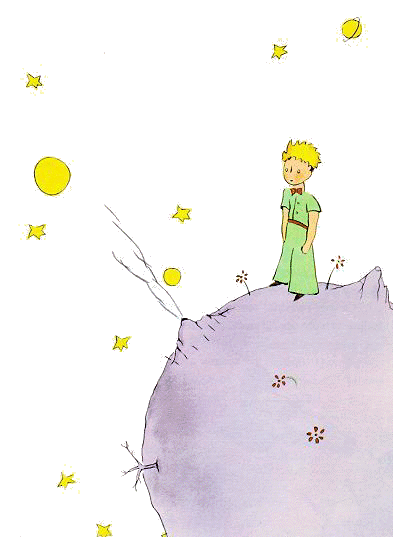
A lot of children's books can be equally enjoyed by adults, too. While many are quite vapid, and assume that young = stupid, some are interesting. They're the kind of books you get more out of, every time you read them. Things like Peter Pan or The Little Prince, for instance. They're obviously children's books, but there's a lot in them for adults as well (honestly, if you've never read them, go take a look - you'll be pleasantly surprised).
The Discworld books and the Harry Potter series have both been given special 'mature' covers, so adults don't feel silly reading them. This is essentially the same as putting a different picture on the packaging for hair dye or moisturiser, so men don't feel silly using girly products.
Thursday, 20 November 2008
In Which We Discuss Big Comics
 Originally a full novel, it has been condensed into what has been called a 'big comic', which I found in the children's section of my library.
It's disappointing, really. So many things have been cut out, in order to make it easier for children to read. I've read the book repeatedly by this point, but I'm honestly not sure if it would make as much sense if one hadn't before reading the comic.
In all honesty, I think the best use of the Mort 'big comic' would be for an older reader to use it to introduce a child to the Discworld novels. An older reader who was familiar with Mort, and therefore able to fill in the gaps in the plot.