I have to admit, The Gunslinger is another one I didn't particularly like. I didn't particularly dislike it either, and I'm glad to have read it, just so I can now discuss it when it comes up.
It's a western. I'm not that big on westerns. And I think Roland is a very stupid and annoying name. I don't know why I think that. I just don't like how it sounds.
The Gunslinger was published in June of 1982. Stephen King was very prolific in that year. The Gunslinger and The Dark Tower series as a whole do eventually connect the vast majority of King's work together, mostly through sharing characters. The Dark Man, Randal Flagg, for instance, we have already seen in The Stand.
I also think Randal Flagg is a stupid name. Probably why he doesn't appeal to me as a character or as a villain. It makes me think of Randal from Recess, which is not really the intended effect.
I don't think The Dark Tower series is for me, but I'll plough on regardless. James Smythe enjoyed it a lot more and has lots of intelligent things to say about it.
Next up is Creepshow. It was released as a graphic novel, with script by Stephen King, but first it was a movie, screenplay also by Stephen King. Since the comic is expensive and the movie is not, I'm going to watch it rather than read it.
Friday, 3 October 2014

Wednesday, 1 October 2014
In Which We Discuss the Running Man
A lot of people have sited this as one of their favourite Stephen King novels. I can't say I'll be joining them.
Running Man was a pretty quick read. Two days, if I recall correctly. I didn't dislike the book, but reading it more than thirty years after it was published, it did not compare well to more modern books. Chart Throb and Dead Famous did the reality TV parody in a way I preferred. I feel like Play or Die did the hunting human plot better.
Running Man was a pretty quick read. Two days, if I recall correctly. I didn't dislike the book, but reading it more than thirty years after it was published, it did not compare well to more modern books. Chart Throb and Dead Famous did the reality TV parody in a way I preferred. I feel like Play or Die did the hunting human plot better.
I think a big reason why I preferred Play or Die was that it was set in a world closer to mine. I had a better idea of the options available to the main character, so I could better evaluate her decisions and therefore her resourcefulness and intelligence. I didn't feel like I could do that with with the Running Man.
Weirdly, wikipedia keeps saying that Running Man is similar to Battle Royale and Hunger Games. No it isn't, not more so than any other novel.
I've never seen the movie, but I gather it's very different from the book. James Smythe has, and continues with his excellent Guardian articles here.
Unusually, The Running Man doesn't appear to have any links with other Stephen King novels.
Tuesday, 30 September 2014
In Which We Discuss Books I Read in my 26th Year, Week 7/52

Tiger Lily I found because I was looking for a specific Peter Pan quote I've always identified with.
“Tink was not all bad: or, rather, she was all bad just now, but, on the other hand, sometimes she was all good. Fairies have to be one thing or the other, because being so small they unfortunately have room for one feeling only at a time. They are, however, allowed to change, only it must be a complete change.”
While looking for that, I wound up on this page, which has a number of quotes from Jodi Lynn Anderson's Tiger Lily. It looked interesting. One thing that always fascinated me about Peter Pan was the fact that every women in the original book was in love with him, and he had no way of understanding that. It seemed like Tiger Lily explored that theme. Plus, it's written from Tink's point of view, and who can not like that?
The book was pretty good. Peter Pan was aged up to make the relationship a bit more believable, and I did like Tink as the narrator, and seeing more of Tiger Lily. I didn't find it as magical as I might have ten years ago, though.
Speaking of ten years ago, Horrorscope is another book I first read as a teenager. I don't know why I like it so much. I guess I do like the conceit of someone murdering people in the order of their starsigns, and the amount of research into horoscope theory that's been done (yes, horoscope theory is a real thing). I like the characters. It's good comfort reading.
Player of Games I read at the last minute for a bookclub. I've been meaning to read some Iain M. Banks for quite a while, so it seemed like a good opportunity. I read it in two days. It was okay. A bit farfetched and unlikely.
Pyramids is another book I first read as a teenager. I got it as an audio-book. It has so much in common with Small Gods that it seemed a natural choice, especially since I'm not particularly fussed about reading the Discworld books in order. I know the series well enough that I can place relevant events in context.
Finally, A Wonderlandiful World is the third part of the Ever After High novels. I watched the webisodes because they were on Netflix, and then I started reading the books. They use some very clever language tricks and puns, especially in those novel when the narrator is infected with something from Wonderland and Maddie appeals to the reader themselves (yes you) in a nod to Peter Pan. This book managed to make me like Lizzie Hearts, who I'd always found slightly irritating before. It also brought out my soft spot for Duchess. It's hard not to, considering her story, even if she is a cow.
Wednesday, 24 September 2014
In Which We Discuss Hundreds of Books
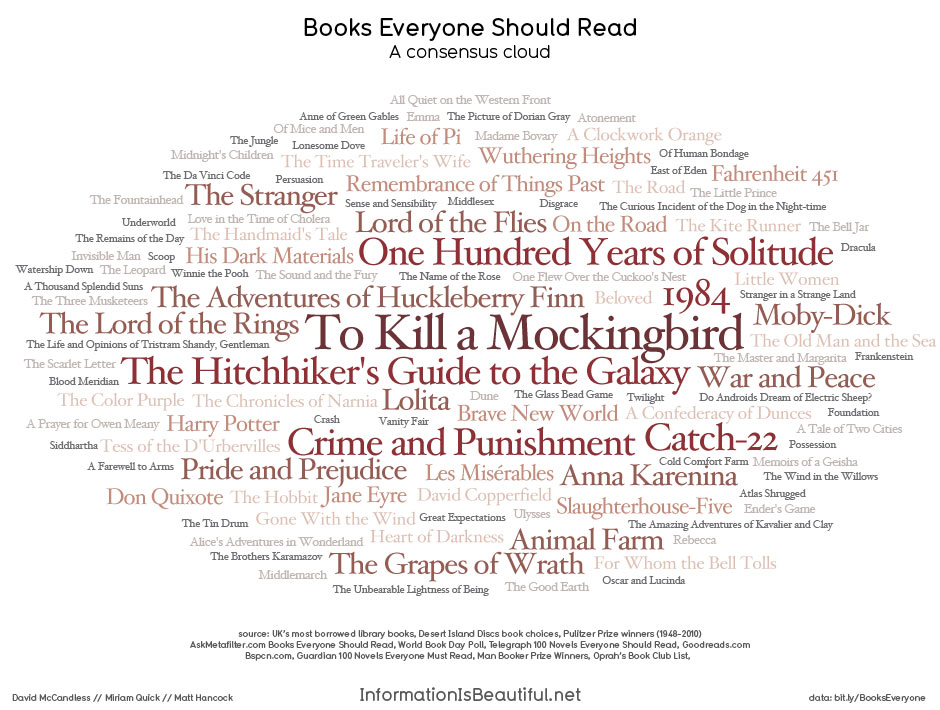
A while ago, the Guardian published Information is Beautiful's David McCandless' infographic which collected together various '100 Book' lists. It includes the 100 most borrowed library books, Pulitzer Prize winners, Oprah's bookclub, and a few others - you can see the full data used here.
The infographic itself looks like this, and you can see it fullsized here.

The infographic itself looks like this, and you can see it fullsized here.
In Which We Discuss Eating Animals You Can Talk To
There are quite a few stories out there with characters who can speak to animals, but very few then go to deal with the dilemma of eating them. Off the top of my head, I can think of three.
Eliezer Yudkowsky's Harry Potter and the Methods of Rationality is an excellent, novel-length Harry Potter fanfic which imagines that Lily was kind to Petunia, and as a direct result, Petunia married a scientist and was more loving towards Harry. Harry Potter-Evans-Verres is a scientifically-minded rationalist who does lots and lots of interesting things at Hogwarts, and I very highly recommend giving it a read. However, what we are concerned with here is what he does when he finds out about Parselmouth, and hears of other spells that can give animals cognisance. He diligently researches exactly which foods are likely to have come from sentient creatures and avoids those he isn't sure of.
In Jinian Footseer, Jinian, who can talk to animals, doesn't eat anything explicitly mentioned as not being vegetarian in the first book. In the second and third, she does explicitly eat meat.
In The Fairy Godmother, part of Mercedes Lackey's 500 Kingdoms series, Elaina drinks dragon blood and begins to understand all animal speech. After listening to the chickens for five minutes she decides it's okay to eat them because they're stupid.
In Which We Discuss Cujo
Cujo was Stephen King's twelfth novel, published in 1981. It's the one he doesn't remember writing, due to his alcoholism. It recalls the events of the Dead Zone, and Sheriff George Bannerman plays a large role in this one.
I read this years ago, when I was nineteen or so, and it's better than I remember it being. It links quite strongly into The Dead Zone which I hadn't read the last time I read Cujo. Specific characters are mentioned, and it's set in Castle Rock.
James Smythe has a very interesting post on Cujo as a metaphor for addiction. I'm lazy and have a cold, so I'm not going to write anything that detailed.
In Which We Discuss Books I Read in my 26th Year, Week 6/52

So, welcome to the end of my 6th week as a 26-year-old.
Walk Two Moons is something of a sequel to Absolutely Normal Chaos. It follows Salamanca Hiddle as she traces her mother footsteps - "walk[s] two moons in [her] moccasins" - and tells her grandparents the story of the last few months. Which she spent in the same town that Absolutely Normal Chaos was set in.
Walk Two Moons is my least favourite of the trilogy, mostly due to one element. Salamanca Hiddle is part Native American, or Nican Tlaca. However, her mother referred to herself as 'Indian', and part of Salamanca's character development is to claim that name for herself. However, fuck off.
I'm Indian. My father's family came over from Gujerat in the 60s. I understand that Native American people didn't choose to be called 'Indian' for a time, but there are unfortunate implications all over the place in this scenario. And I resented it. Indian is the name for people from India. Claim your own identity, not mine.
Chasing Redbird on the other hand, is my favourite one of the trilogy, and the first one I read. I must have been around thirteen. Zinnia Taylor, in trying to deal with the recent death of her aunt and the more historic death of her cousin, starts trying to uncover a twenty mile trail. I liked the characters, I liked the plot, I liked how it was played out. It's loosely connected to the other novels in that Zinnia was once Salamanca's best friend - although Sal doesn't mention Zinny at all - and that Zinny lives in the area Sal remembers with such fondness.
I first read Life and Laughing a couple of years ago. I like how happy Michael McIntyre is about his life. Not all the time - he goes through trouble with family, his dad's death, unrequited love, lots of debt, and so on, and then it all works out. I got it as an audio book because I like his stand-up and thought it would be fun to hear him do all the voices, and to actually hear the joy in his voice. It was.
I first saw The Illustrated Treasury of Disney Songs at the library. It has songs from the golden age of Disney, ranging from the early years of Minnie's Yoohoo to the 90s, with vocal lines and the bass and treble lines for piano. I like it.
Cujo was better than I remembered. I read it over two or three days, then got through The Running Man in another two. It was okay. Short. I preferred Play or Die. I'll go into why more in my longer post about that.
I'd heard about If On A Winter's Night, A Traveler a couple of times, and it sounded interesting. The overarching plot is about you, (yes, you reader) reading Italo Calvino's new novel If On A Winter's Night, A Traveler. However, various shenanigans mean that, instead, you end up reading the beginning of ten different novels, none of which you are able to finish. Once you have read these novels, the framing text begins to take on elements of them, ie, after reading a detective story, the narrative takes on elements of that.
Finally, The Adventures of Sherlock Holmes. This was the third Sherlock Holmes book published, following A Study in Scarlet and The Sign of Four which were both novel-length adventures. Adventures is a collection of short stories originally published in The Strand magazine, and this collection includes The Speckled Band, The Red-Headed League, and the Adventure of the Copper Beaches, among others. I first read it when I was somewhere between nine and twelve. I reread it during quiet moments at work this time round - the entire book is on wikisource along with all the other Sherlock Holmes stories and Sir Arthur Conan Doyle's other works.
Subscribe to:
Posts (Atom)