Monday, 13 May 2019

In Which We Discuss War and Peace, Part 2, Chapters 20 & 21

Chapter 20


The battle appears to be lost, and the regiment's general is so upset at the thought that he might be blamed for this that he charges straight through a line of bullets towards the French.  He gets all the way through and out the other side, to more Russian soldiers.  He tries to command them, but they're all too panicked.  But then the French suddenly retreat because Timokhin's company has crept up behind them, so that's all right.  Dolokhov captures a French officer, and makes sure to point it out to the commander.



Everyone had forgotten to tell Tushin's regiment to retreat, but the French didn't attack them because they didn't believe anyone would continue to attack from unguarded guns.  Tushin's excited about the village being alight.  Poor village.  The breeze is spreading it.  Tushin didn't have time to be afraid, he was so focused on running his regiment.  He's named all the guns and talks to them while he fights, imagining he is a giant throwing cannonballs at the French.  Prince Andrew finally gets the message to retreat through to Tushin, and helps him pack up the cannons.   They bond quite a lot in that very short period.

Chapter 21


It's getting dark and the battle is still going.  The surviving troops have been ordered to abandon the wounding, but this is difficult as many of them drag themselves along behind them and call for help.  Tushin has found room for two of them, one of which is Nikolai, who seems to be basically fine apart from a sprained arm.

It's now dark enough that the soldier's can't see each other, so the fighting dies down completely and people start coming out to compare scores.  The Russian forces are positive that they've won this one and celebrate with vodka.  Clearly, vodka is a drink for all occasions.  Like tea.

(I am British).

They've captured a French soldier and haven't bothered to feed him, which seems a bit rude.  Officers are flocking in to look at the colonel Dolokhov captured.  They're also informing Bagration of their actions during the battle, and at least one is taking a little bit of artistic license in making himself out to be a bit more skilled and intentional than he actually had been.  Another claims that he and Prince Andrew had only just missed one another, but Andrew flat out denies it.  Bagration believes that the left had retreated very early on, and is asking how two guns in the centre came to be abandoned.  Tushin walks in in the middle, believes he's asking about something that happened on the left and gets flustered, but Andrew is able to explain everything, stating that they owe today's success to Tushin and his battery.  Tushin thanks him, but Andrew's too busy feeling sad about war not being at all like he thought it would be.


Rostov has managed to fall asleep, despite his arm, but now he's having fever dreams about everyone back home. He wakes up, and starts feeling sorry for himself because the doctor hasn't arrived and no one is looking after him.  He is regretting this whole war business.

The chapter (and book 2) end abruptly, by telling us that the French army did not renew their attack, and what's left Bagration's detachment is joined back on to Kutuzov's army.

I like this habit of reading a chapter a day - did I mention that I was doing that?   I am, though I'm not always publishing the post every day, it depends how long it is.  I'm now 17% of the way through War & Peace.  I hope the next book is a Peace one, I do find those parts more interesting.

Saturday, 11 May 2019

In Which We Discuss War and Peace, Part 2, Chapters 18 and 19

Chapter 18


Prince Bagration is charging into the action and we're beginning to see the wounded and dying coming the other way.  Some are unwounded but retreating anyway.


Bagration - trailed by Prince Andrew - gets an update from the Commander of the regiment.  He's lost half his men, though they have successfully repulsed the French cavalry.  The narration tells us he's not actually certain that the attack has been repulsed, but the French haven't actually reached him yet, so that's a good sign.  Prince Andrew is stuck by Bagration's expression, which is suddenly electrified.  The Commander is trying to persuade them to retreat, but Bagration is ready for action.  Bullets are whistling around them now.  The mist rises, and they can see the French.  The chapter ends with Bagration ordering this regiment to charge.


Chapter 19


Tushin has successfully set fire to the village.  I am still unclear on why he wanted to do that, except for maybe he just hates the French.


Like, I get that there's a war on, but firing over the soldier's heads into a village seems unnecessary.  Tushin was the centre, delaying the French advance, the right flank is retreating, and the left flank is being trounced.  Zherkov has been sent with orders that the left retreats immediately.  He sets off, but panics as soon as he's out of sight of Bagration.  He decides that the general and officers are probably somewhere well away from the fighting, and so looks for them where they could not possibly be and never delivers the order.

The left actually has two commanders, the one commanding Dolokhov and Rostov.   The two commanders have been fighting each other this whole time, and no one expected a battle so no one was ready.  The German hussars decide to retreat.  I am unclear if they are one of the two left sides or like a seperate bit within the left.  A Russian generals asks the German colonel to call his men back, but he won't.  He invites the Russian to come and look at how bad the position is, because he refuses to destroy his men for fun.  I think these two might be the commanders who are fighting.  They ride to the front while continuing their argument.  They stay there because neither is willing to be the coward who leaves first.


The Hussars don't have the option of retreating anymore because they've been cut off by the French.  The German hussar commander is Rostov, but it took until this part of the chapter to actually say his name.  Both commanders have decided to attack now.  They're having fun.  Right up until Rostov and his horse are wounded, and Rostov is nearly captured by the French.  For the first time, Rostov seems to realise that he might actually die.


Thursday, 9 May 2019

In Which We Discuss War and Peace, Part 2, Chapter 17

Chapter 17

Prince Andrew hops back on his horse and looks over to see that, yep, a battle has started on his left.  He gallops away from the cannons and towards Prince Bagration, because his role is to help him.  The French have just received Bonaparte's letter, and Murat, the leader of the French forces, is trying to crush the Russians before Emperor Napoleon turns up.  This all seems very inefficient.  The Russians have been interrupted from their breakfast of porridge and vodka.  I suspect this novel is where all of the stereotypes originated.


"'Here it is, dreadful but enjoyable!' was what the face of each soldier and each officer seemed to say."

Presumably, we're now back to Carrying On Up the Danube.


Even Prince Bagration appears to have caught battle-fever, as Prince Andrew judges from his face.  He has an Oriental accent - I don't know what that is, or why he has it.  The troup - including an accountant who has tagged along for fun - head over to Tushin's battery.  I'm not joking about the accountant, that's literally why he's here.   He has a stomachache.


They're back where Prince Andrew was at the start of the chapter.  They see someone die along the way - knocked off his horse by a 'Franch pancake' - which the accountant finds rather fascinating.  Tushin is meant to be firing at the enemy, but he's decided to set fire to a nearby village instead - again, not joking, he's literally decided that - and is firing over their heads.  As Prince Andrew follows Bagration around, he notices that Bagration doesn't actually give orders, he just gives the impression that everything his men have decided to do, or that has happened accidentally, is exactly what he intended. 

Wednesday, 8 May 2019

In Which We Discuss War and Peace, Part 2, Chapters 15 and 16

Chapter 15

We go back a little in time for now.  Napoleon has not yet arrived to tell his army to attack.  Prince Andrew has arrived and is reporting to Bagration.  None of the men really believe in a truce or an upcoming battle, and Bagration reassures Andrew that there won't be a battle today, but gives him the option of going into battle (the hard way) or hanging out at the back of the troups.  Prince Andrew takes the hard way, and goes on a tour to see where everyone is, in preparation.  The troups get more and more orderly as they get closer to the front line, until he gets there and sees that the French and Russian soldiers - specifically Dolokhov, because it's always Dolokhov - are trash talking each other.  It's all very 1915 Christmas football match crossed with a rap battle.


Also, the French guy has mixed up the Russians and Austrians.


Chapter 16

Prince Andrew is now doing stuff the hard way.   He's ridden out into a position from which he can see all of Russian army and most of the enemy.  One thing that surprised me here is that the narrative started referring to 'our right flank' and 'our infantry', when previously it's been more objective.  Prince Andrew's making a battle plan, since the French are indeed, three times as strong and able to hem them in on both sides.  He begins fantasising about himself as a great shiny hero and strategy genius.  I'm also reading Philippa Gregory's Cousin's War books right now, and that's led me to become a little bit obsessed with Richard III.  It wasn't all shiny armour for him, when he was knocked off his horse, killed, stripped naked, and carried through the town to prove that he was dead.


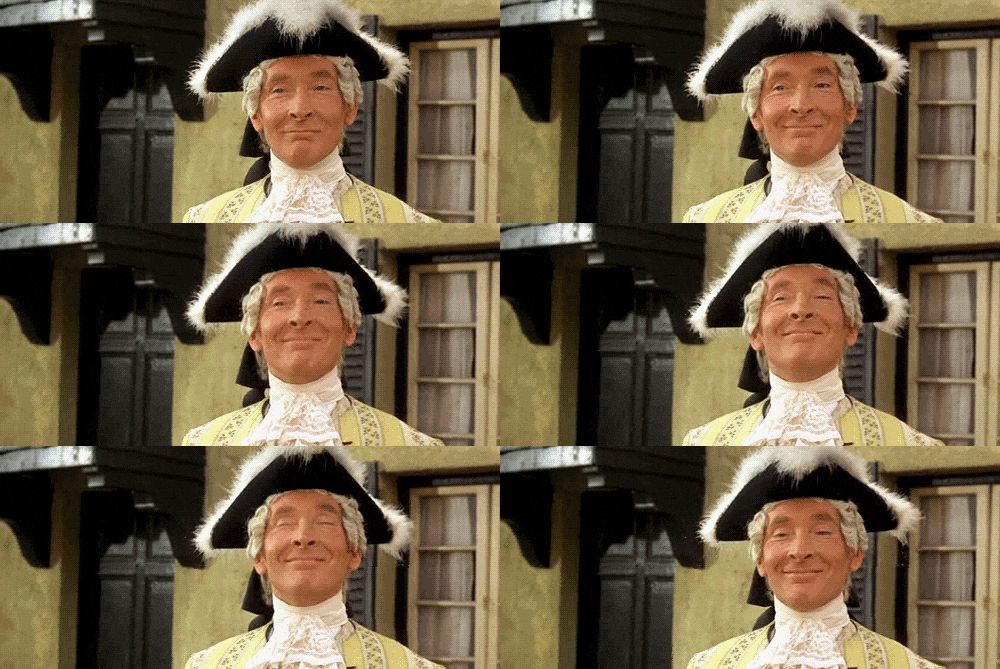
I spent far too long trying to find a good gif from the first season of Blackadder - ideally, his shock at having accidentally murdered Uncle Dicky - but apparently that's not a thing, so have this image of Henry Tulip instead.

Prince Andrew overhears some three soldiers - including Captain Tushin, who has apparently appeared previously but who I don't appear to have mentioned because I didn't know he'd come back - drinking vodka and philosophising about death.  Suddenly, a cannonball hits the ground near the shed they're talking in and Tushin and the others rush out.

I know it's been a long time between posts, and, tbh, my eyes start to blur over when Prince Andrew is fantasising about tactics.  I've made reading a chapter part of my nightly routine, so hopefully it will go a bit faster!

Thursday, 15 November 2018

In Which We Discuss War and Peace, Part 2, Chapter 14

Chapter 14

Napoleon is coming for Kutuzov's army of 40,000 tired Russians, so his choices are to remain and engage Napoleon's 150,000 cheese-eating surrender monkeys, wander into the Bohemian mountains to try to find a route of the road, or retreat back to Olmutz to meet more more soldiers who are russian to meet him.  He picks the latter, which has a risk of meeting the French who had crossed the Vienna bridge, who are three times as strong and will be able to hem in in on both sides.  I am no general, but that does not seem like a good thing.


The French are are heading toward Znaim, 66 miles away.  If Kutuzov reaches Znaim before them, he can block them, I think?  He sends Bagration out with a vanguard of 4000.  Their job is to stop the French entering Znaim from Vienna.  A third of them are lost during the forced march, but they make it!  Still, they are knackered and hungry, and having to face the entire enemy army, which is clearly impossible.  So Bagration pretends a truce is being negotiated so the French won't attack for a bit and his men can recover.  It works until Napoleon sends a letter telling his army they've been tricked, and decides to deliver it himself, with even more of his army.


Bagration's poor men are trying to enjoy a nice breakfast of porridge for the first time in three days. And that's where the chapter ends.  Dundundun....


Friday, 14 September 2018

In Which We Discuss War and Peace, Part 2, Chapters 11, 12 and 13

Chapter 11

In the morning, Prince Andrew needs to be presented to the Emperor Francis.   He goes to Bilibin's study where Prince Hippolyte Kuragin (son of Vasili and brother to Anatole and Helene) is waiting, among others.  They are a collection of "young, gay society men" (smirk), almost exclusively diplomats, and have interests related to "high society, certain women, and the official side of the service".  They meet up and gossip a little bit about society, but mostly about the women.  Like The Inbetweeners, if they had better clothes and jobs.  Prince Hippolyte is the one they all make fun of.

Chapter 12

Prince Andrew is finally in front of Emperor Francis.  He's not very interested in hearing Prince Andrew's dramatic story and keeps interrupting with boring questions like "what time did the battle begin?".  Afterwards, Andrew learns that an important bridge has been crossed by the French army, despite it being fitted with bombs and ordered to be blown up to prevent exactly this.  No one knows why it wasn't destroyed, and the Russian army is cut off.  Prince Andrew is thrilled; this his clearly his destined opportunity to be a war hero and lead the Russian army to victory from the jaws of defeat.  Bilibin tells Prince Andrew that the French took the bridge by trickery, which seems to impress him.  When he realises that Prince Andrew intends to return for honour and glory or some other idiocy, he tries to persuade him not to, and calls him a hero.  I have decided not to read it as a compliment.

Chapter 13

Prince Andrew sets off for the army - though he doesn't know where it is - while the rest of the court packs up to head to Olmutz.  Prince Andrew is having happy dreams of either winning or dying gloriously, whichever comes first.  As Terry Pratchett would say, there's an important word in that sentence, and it's not the word "gloriously".

Prince Andrew manages to accidentally stumble into the army.  I guess an army is a hard thing to miss.  He gets poached by Kutuzov, despite wanting to go with Prince Bagration, who I swear we haven't met before.  I think that's the group his friends are in.  Kutuzov will hear none of it.

Okay, I googled, and Pyotr Bagration is a real Russian general whom Tolstoy considered the "hero of heroes".  He dies at Borodino in November 1812, so we have that to look forward to.

In Which We Discuss War and Peace, Part 2, Chapters 9 & 10

Chapter 9

The Russians are vastly outnumbered by the French army and the civilian population are not greeting them as heroes, as they had expected.  This is not going well.  They are also out of supplies, and so they are retreating, fighting only enough to protect their equipment.  However, even their enemies acknowledge that they fight with courage and endurance - and it's the third-person narration saying this, not darling Bory's mother - which still only serves to make them retreat faster.  This is a solid, tactical move, but not the noble war they thought they'd be fighting.  Kutuzov was instructed, by Austrians, to mount an offensive at Vienna, but that plan has gone out of the window.  His only goal is to join with the advancing Russian forces without losing his entire army "as Mack had done at Ulm".  I'm sure the text has referenced Mack before.  Yes it has, in book 2, chapter 4 and I talked about it then.  Mack is Karl Mack Von Lieberich, who suffered a defeat.  This was a big deal, presumably because he lost his entire army.

We zoom back in on the 28th of October.  The Russians have actually beaten back a French division and taken banners, cannons, and two generals!  They are very pleased about this.  Rumours have begun that they have - or will very shortly - beat back Napoleon himself.  The Austrian General Prince Andrew was buttling, or whatever the term is, has been killed in action and so Prince Andrew doesn't have a specific job right now, so he gets sent to tell the Austrian court of the Great and Glorious Russian victory.  Apparently this is an important step towards a potential promotion.  Also, Prince Andrew has a deceptive level of physical endurance, considering his lack of musculature.  We're following him, as he rides along in the night, enjoining the calm and the sense of accomplishment and having happy little daydreams about how excited they'll be to see him and how grand his proclamations will be.  That begins to fade as he gets closer to delivering his message and he begins to feel disdainful towards those far from the front lines.  The minister of war is indifferent, and Prince Andrew is left feeling hollow.

Chapter 10

Prince Andrew is staying at Brunn with Bilibin, a Russian diplomat.  Is he not going back to the war zone?  He's enjoying all the comfort he's been deprived of anyhow.  He's also happy to be speaking to a fellow countryman, even though they're speaking French.  Bilibin and Prince Andrew knew each other back in St Petersburg, and both are young men with promising careers.  Prince Andrew complains about his reception, and Bilibin points out that it wasn't a very impressive victory.  Prince Andrew points out that the Austrians have been losing, so how can they be unimpressed by a Russian victory?  Because they're Austrian, is the answer, and also because Viena isn't liberated from the French, Bilibin explains in French.  Prince Andrew begins to understand that his news really isn't all that impressive.  He is very small and sad.  Still, he gets to spend the night in a nice, clean, feather bed with "warmed and fragrant" pillows, so it's not all bad.  The battle has now become a happy daydream and a story about his own heroics.