Wednesday, 6 December 2023

In Which We Discuss War and Peace, Part 16, Chapters 1-3

 Part 16, Chapter 1

This is another of Tolstoy's historical essays. In this one, the subject is Alexander I, and who has the right and knowledge to judge if he made the right decisions. Tolstoy's answer is no one - any historian can be accused of the same short-sightedness that he might see in Alexander I, and their judgement is just as likely to be found wrong 50 years later.


Chapter 2

Another essay, on chance and genius and the distinction between them. I think Tolstoy is suggesting there is no distinction - we call it genius if, the person making the decision, by chance, choose something that leads to a desired outcome.


Chapter 3

Another essay; this one a scathing takedown of Napoleon, attributing everything he does to ego and luck.

Tuesday, 5 December 2023

In Which We Discuss Converting to Judaism

 About 5 weeks ago, I realised I want to convert to Judaism.


In some ways, this realisation was a very long time in coming. I attended a Catholic primary school which meant, between the ages of 5 and 10, I was taught to pray at least three times a day, attended mass every week, and Catholic ideas filtered into every lesson. 


The UK doesn't have separation between church and state, so every school is required to include religious observance in assemblies. By default, this is Church of England, the state religion of the UK, but schools can apply to offer another religious service instead. While Jewish and Muslim schools tend to be criticised and accused of indoctrinating students, to my knowledge, Catholic schools don't garner those kinds of accusations. But that's a rant for another time.


I rejected Catholicism before the age of 10, because it annoyed me. Specifically, the fact that it was internally contradictory and you weren't allowed to talk about why. 


For example; why would anyone assume that Jesus' immaculate conception meant that Mary remained a virgin for the rest of her life?* And, having assumed that, why would you not then question the appearance of Mary and Joseph's children in the Gospel of Luke? 


*to control women.


For example: why is it so obvious that Ruth and Naomi shared a platonic love? My reading of the Book of Ruth reveals a story about a lesbian couple and a gay man happily co-parenting and everyone deciding to mind their own business about it.


For example: why would you accuse the Jews of killing Jesus? The Gospels describe the idea of a 'Paschal pardon', that the Jewish elders were offered the chance to free a prisoner, and they chose Barabbas instead of Jesus. Firstly, why is choosing Barabbas wrong? That's like saying, if I give my sister a kidney, I've murdered a total stranger who also could have used a kidney. Secondly, the Jews had zero power. I don't care how many times Pontius Pilate washes his hands, the Romans were 100% in charge and responsible for their own actions. The Jews could do nothing. Thirdly, it's outright suspicious that the concept of a Paschal pardon isn't supported by any historical documents outside of the Gospels. It's not even consistent in them - it didn't originally appear in Luke, but was added much later.


...anyway. I couldn't be a Catholic. It made no sense to me.


(Full disclosure; the above points aren't what I remember frustrating me when I was a child, they're things that frustrate me now. I don't remember the specifics of what bothered me, just the feeling that something wasn't adding up and the frustration that no one would talk about it).


But, I missed it. I missed the rituals and the ceremonies and the singing. I missed reading the Bible. 


I wasn't actually supposed to read the Bible. Catholics aren't. They're supposed to read the Catechism, i.e., the Pope's interpretation, and go along with that. But someone gave me several children's Bibles, which included the stories of the "old Testament" and I read them. I liked thinking about them and I missed them.


Because I missed those aspects and because I liked reading and interpreting the Bible, I've spent most of the last 25 years identifying as a Bad Catholic. A Catholic by upbringing, but not by belief.


Last February, I started writing for my work newsletter. I started with Purim, which is a Jewish holiday. I knew there was a great deal of overlap between Christianity and Judaism (and Islam, which is why I also wrote those articles) and my co-worker, who is born and raised Jewish, was willing to check that what I wrote was kosher (right, correct).


As I read more about Jewish beliefs, I kept finding myself going, "See, that's what I think. That's why I'm so bad at being a Catholic. Catholics aren't allowed to think that."


I told myself it was an academic interest. That I was being a good ally (and, from feedback, I do still think I'm quite a good ally).


After October 7th, I realised that what I was feeling wasn't what I normally felt as an ally. I wanted to be with the people who felt like me. I wanted to support them. I wanted to stand with them and be seen as one of them.


At some point, I looked up the conversion process, still telling myself my interest was academic.


A few days after that, I woke up and knew I wanted to convert. It felt like when I realised I wanted to marry my fiancé. In hindsight, I can see all the signs creeping up on me, but I didn't feel it growing. The feeling was just there one day, whole and complete and undeniable. 


'Convert' doesn't feel like quite the right word. I don't expect to change. I'm not going to become something new. I just want to learn how to express this part of myself. Which, I later learned, does align with how Judaism sees converts - they always had a Jewish soul, they just didn't have anyone to teach them how to be Jewish.


What that means is, I am having a lot of new feelings and thoughts and ideas that I want to share. And since most of those will be linked to the weekly Bible portion (the Parashah), this blog struck me as quite a good place to write about them.

Saturday, 28 January 2023

In Which We Discuss Assumptions and the Holocaust

Last year, I wrote a post about whether Hermione (of Harry Potter) is white. In that post, I pointed out that people seem to need only flimsy evidence to assume someone matches the 'default' - e.g., white, male, able-bodied, cis, straight - but very strong evidence to assume someone is 'other.'


I thought of this recently because I did exactly that myself. That is, I assumed the status quo based on weak evidence and ignored strong evidence to the contrary. Someone I've known for a few months now is Jewish and it took several hints and outright asking for me to know that for sure. 


I could say, "I didn't want to assume," but, of course, I was making an assumption either way. It's just which assumption. But, I knew he had a relative living in Israel ("but that could be because of the relative's partner!") and I knew his name was Jewish ("but it could come from the alternative French source!"). On the flipside, I knew he didn't keep kosher, or, rather, had quite strong evidence that he didn't (but many Jewish people aren't strict about that), and I think I've known him to use technology or otherwise not strictly observe the sabbath (but, ditto, and also I could just be misremembering). Also, he said "Merry Christmas," but, as he pointed out himself, he knows that Christmas exists, and I know I had previously mentioned in a group conversation that I'm (culturally) Catholic, though he may not remember that. Either way, I know that Hanukah and Passover (etc) exist and I'm not Jewish or even living in a predominantly Jewish society. I feel like I'm in a very small group because only 3% of the UK population tick the 'mixed-other' box like me, but even fewer people tick the box marked 'Jewish' -  only 0.5%.


I haven't changed the opinion expressed in that post. People make assumptions. We should know we're doing it so we can correct it on the occasions when we get it wrong, instead of blindly or defensively arguing for whatever assumption we're making. In theory, I could be defensive and argue that I was right to assume the default, but why? Why would I do that? Just go, "Oh, interesting,", correct your mental notes/tags, and move on with your day. Or, if it's a fictional character, just go, "Oh, I guess you could see it that way," and then either decide to carry on picturing the character however you were before, or change, or flip back and forth, based on whatever suits you.


I think the first reason I wanted to share this because it's really easy to notice when other people are making errors in their thinking, but much harder to realise and acknowledge when you're doing it. The second reason is, Holocaust memorial day was yesterday, 27th January. That's the anniversary of liberation of Auschwitz-Birkenau, the largest Nazi death camp. This year's theme is 'Ordinary People.'


I didn't intend this when I started writing, but I think what I talked about above ties into that theme. Most people assume other people are probably like them, and that tomorrow will probably be a lot like today. It's okay to assume that - you'll get the right answer a lot of the time, and if you never, ever made any assumptions, you'd never get through the day. Plus, if you feel afraid or insecure, assuming other people don't feel like you is, in my experience, more likely to be wrong and cause you unhappiness than assuming many people will feel the same way. The trick is, again, you have to know you're making assumptions and be ready to pay attention and correct them if they're wrong.


The other thought-error we make about the Holocaust is, at least in British schools, to treat it as an anomaly, something that came from a unique evil or a unique time in history. To me, at least, the attitude is "Isn't what Germany did terrible? We must never, ever be like Germany!". Which isn't wrong exactly, since obviously the Holocaust was terrible and must never be repeated, but it does innocently gloss over terrible events the British Empire was involved in, like Partition, or basically everything Europe did in Africa or to African people. It also, somehow, ignores the part where the Allies didn't liberate everyone from Concentration camps, and even punished people like Alan Turing for being gay. 


We get the impression that antisemitism was a thing that happened once, when the Holocaust was the culmination of a hatred that had been growing for thousands of years (I actually learned that from visiting museums in Hamburg, but I looked for a source I could share). Ordinary people think "it can't happen here" or "it was an aberration that won't happen again." I suspect a lot of ordinary people in the 1930s thought it couldn't happen there or then (link is about Martin Niemöller, who wrote the poem First They Came).


The links above have some suggestions for further reading. I haven't read much about the Holocaust, but I would recommend Maus, a graphic novel by the child of two holocaust survivors. I've never read The Diary of Anne Frank because, to be honest, I don't think I can handle it, but it's an obvious one to mention. She knew her diary might be published - based on a radio broadcast, which mentioned that the diaries of ordinary people were a good historical record - and began editing it during her lifetime. The diary was also edited by her father, the only surviving member of her family. One of the things that was removed - I think, by Anne herself - was the fact she was bisexual. On the one hand, I'm opposed to reading private diaries except when, like in the published version, the writer themselves intended it to be read. On the other hand, it's important to acknowledge all the victims of the Holocaust, including the LGBTQ community, and even though she would have been persecuted "just" for being Jewish, her bisexuality would also have been dangerous.


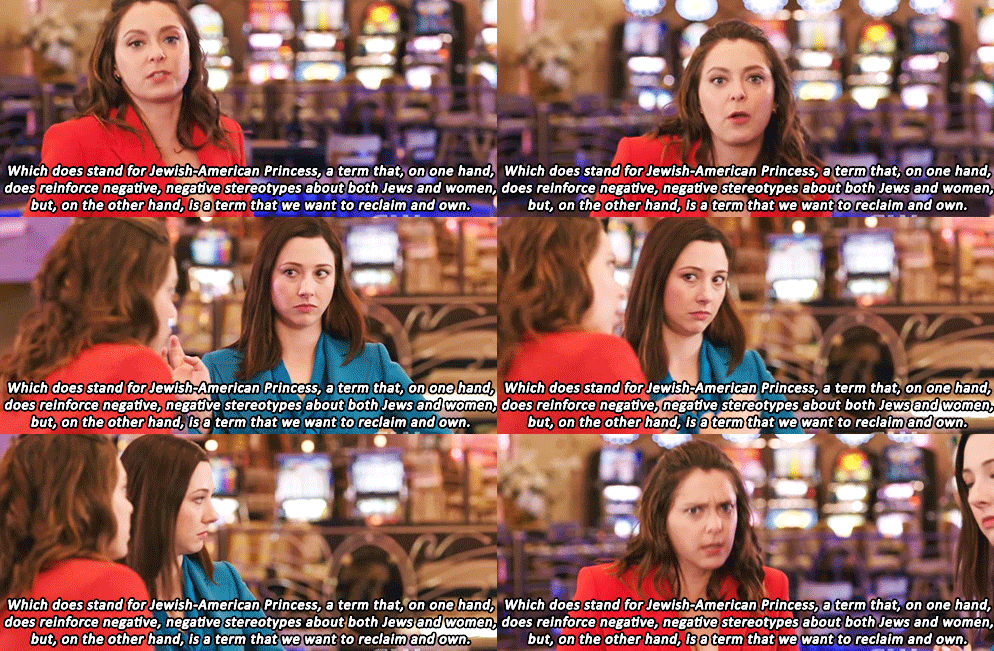
One of my favourite books is The Basic Eight by Daniel Handler, who is Jewish, though that's not what the book is about, apart from in the way a person's culture/viewpoint informs all creative work. The TV show Crazy-Ex-Girlfriend is similar, in that sense. It's not about being Jewish, it's about a specific person who is Jewish. 


An interlude in the song 'JAP Battle'


Being Jewish, like being of any other group, is a category, which means the individuals within that category aren't identical. They have enough traits in common to be in the category, but exactly which traits and to what extent vary. The solution is to read (or watch, or talk to) a lot of different representative viewpoints, to get an idea of the overall picture. Like at football matches, when dozens of people hold up squares to create an image. For instance, I could hold up my square, for my experience of being mixed race or being neurodiverse, but mine only represents me. You need to look at a few more to get a feel for what the overall image is. It's the same for any other group humans might be part of.


In addition to the links above, I found the following while googling but didn't end up specifically referencing the content: Hey Alma; Forward; 1938 ProjektI also learned that Kafka was Jewish and about an upcoming game called A Light in the Darkness which aims to educate people on the Holocaust. I found this article on celebrities you might not realise are Jewish or have Jewish heritage, such as Rashida Jones, Jack Black, Daniel Radcliffe, Winona Ryder, Maya Rudolph, and Zoe Kravitz. They all have different relationships with Judaism because of course they do. The article has a few links to where that's been further discussed, like Bob Saget being interviewed on the Jewish Federation of LA Podcast.

In Which We Discuss Matthew Perry

...because I just read his autobiography. Overall, it's like watching seasons 1-3 of Bojack Horseman - so dark, but before it gets really dark - interspersed with the occasional clip from Friends to lighten the mood a bit. Also, Perry is very witty. It's possible that he paid a really good ghost writer and the jokes aren't actually his, but I personally don't believe that to be the case. 


Matthew Perry's father left when he was 9 months old, and his mother was always busy and distracted. Which, he says multiple times, he understands and doesn't blame them for, but he can't deny the effect it had on him. It makes sense - he obviously doesn't remember his dad leaving, but when you're a baby and the adults caring for you leave or are distracted, it sets off an alarm inside you, because that's a matter of life and death for babies. In some people, the alarm just never gets switched off.

He felt like it was his job to keep his mother happy, to make her laugh, and doing that made him happy. She'd turn, and pay attention to him, and he'd feel safe, because, in that baby-alarm, attention=safety. So he kept chasing that. Never allowing a silence, always seeking a laugh (god, imagine being like that (the joke here is, I am exactly like that)).

The most interesting thing Matthew Perry says is that fame didn't solve any of the problems he thought it would. He was just famous, with all the same problems. It makes sense that he thought it would - he wanted attention, and to make people laugh, because he associated that with love and safety - but it also makes sense that it didn't work. The problem is, when you're an adult, you know that making people laugh actually doesn't mean they'll take care of your emotional needs or stick around. It only makes you feel better for a few seconds. Then the anxiety comes back. You want that security and you don't know how to get it and keep it. All you know is how to get attention. So you think you need to do it more, or better, and if you did it well enough, you would finally be happy.


Matthew Perry is arguably one of the most successful human beings ever, in terms of making people laugh. Friends had an audience of millions. He was paid over $1mil for a 25 minute episode of making people laugh. I think being so successful at it might be the only reason he figured out it wasn't working, because lots of people don’t. Every person in the world could line up to tell him they loved his work, and it wouldn't make him feel secure or happy, or like he deserved to exist as a human being. He achieved his lifelong goal of having the number one movie and the number one TV show in the country at the same time, and he couldn’t even enjoy it because he was in rehab.

My current theory is, trying to earn the right to exist – via laughter or anything else - doesn't work because it's the wrong question. It’s like asking how much you’d have to pay someone for them to truly love you. It’s the wrong currency. You can’t earn the right to exist. It’s intrinsically yours because you do exist. Like I think, therefore I am. I exist, therefore I deserve to exist.

The other problem is, when people did love him, he didn’t feel secure. I get that. Like the Savage Garden song, “If love was red then she was colour-blind. All her friends have been trialled for treason and crimes that were never defined.” You test your relationships and put your friends on trial because you want to prove they’re unbreakable, that the other person will always be there, that they’re safe, that they can fulfil you. It doesn’t work. The relationship will break if you try to break it. The only way it couldn’t is if that person loved you unconditionally, the way a parent loves a child. That isn’t how adults love each other, romantically or platonically. Love between adults is conditional. Who you are and how you treat each other matters. If it didn’t, you would just love everyone and anyone, equally, with no bias, and if someone loves you like that then it doesn’t matter who you are. You could be anyone. 


So you want unconditional love, but unconditional love isn’t fulfilling. It isn’t being loved for you. The only way to win that game is not to play. Which is where the alcohol and drugs came in. They let him not think and not feel anxious for a while. Until he reached the point where ruining his life with drugs and alcohol was the thing he felt anxious about. Hopefully he figures that one out. He's been sober and drug free for 18 months as of last October, according to The Times, and I hope it sticks.

Friday, 4 March 2022

In Which We Discuss Whether Hermione is White

 I live in a society where the default is assumed to be white, male, cisgendered, heterosexual, able-bodied, and neurotypical. If you were to draw a stickman or mention the "hero" of a story, those are the traits that person has unless you specifically tell the audience that they aren't. This is why, for example, cartoons and costumes get things like eyelashes or bows added to them, to signify that they are women. In this society, people act like you need very, very weak evidence to assume a character matches that default and very, very strong evidence to think they are something 'other.'


Take Sherlock Holmes, for example. Personally, I think it's very clear that he is asexual. But, every adaption I've ever seen has treated him as straight, based purely on him admiring one single woman who appears in one story. Arguably, since he admires lots and lots of men, it would make more sense for him to be gay. But we don't imagine Sherlock Holmes as gay, because we would need something stronger to think that about him.


Similarly, take the Doctor, of Doctor Who. One of the earliest things that we learn about the doctor is that s/he is changeable. Their body changes. And yet, people argue that he is a man. Assuming he has some control over his regenerations, it does tell us something about him that he has repeatedly chosen white, male bodies, but that doesn't mean he must always choose white male bodies. If I got to have twelve different bodies - or twenty-four, or however many the Doctor gets now - I would definitely choose to be a man at least once, just to see what it was like. Why shouldn't the Doctor?


There's a concept called 'death of the author', that is, when you consider a work only based on what is in the work itself and totally ignoring the author as part of it. Alternatively, you can choose to include the author in how you interpret the work. Another way to think about that is to consider, when you ask "why did this happen?", are you asking Sir Arthur Conan Doyle or are you asking Dr John Watson? If you wanted to know "Why is Sherlock Holmes beating up a corpse when Dr Watson first meets him?" then Dr Watson would explain that Sherlock wanted to know what bruises looked like when they were caused after death. That's the Watsonian perspective. The Doylist perspective might be something more like "I wanted to show the reader the amount of research Holmes does, that he doesn't shy away from the gory elements, and that he is a strange man who cares more about the truth than about being polite."


So, when we ask, "is Hermione [of Harry Potter, not A Winter's Tale] white, are we asking JK Rowling or Hermione?". JK Rowling tweeted out her answer a while ago. 


[I should be totally clear here; Rowling is a TERF and has made multiple offensive tweets clearly stating her views, which are based on unfounded fears. I'm not saying or implying that her tweets are right or relevant to literally anything except the exact question of 'What does the author have to say on this element of her work?']

As far as Rowling is concerned, Hermione can be black. I suspect that Rowling intentionally avoided describing Hermione's race because it was totally irrelevant to the story. That's why she felt confidently able to say that "white skin was never specified."


And yet, some people have argued that, from a Watsonian perspective, Hermione is white. They base this on a quote about "Hermione's white face peering out from behind a tree." This is an example of what I was saying above, about people generally only needing very, very flimsy evidence to say a character matches the default, but strong evidence to say she is anything else. 


Let's think about the information being conveyed by that sentence. Do you seriously think that the middle of a dramatic scene, three books in, was when you would receive information about a character's race? You looked at that line and thought "yes, this is a good time to learn about Hermione's skin tone, that is very relevant information here"? Really? You're sticking with that? You're a fuckwit.


The sentence is there to tell you that Hermione is scared, that she is "white with fear." Guess what? I'm not white but I could go white with fear. Meghan Markle isn't white and she could go white with fear. Lots of non-white people are pale enough to go white with fear. And if you have any fucking doubt about whether Rowling was conveying information about race or emotion with that sentence, she outright told you. To think otherwise is to be wilfully ignorant.


This makes me very angry, because the context I see it brought up in is generally people of colour pointing out that it's totally fine to picture the character as looking like you/them, and then white people say "BUT YOU HAVE TO ACKNOWLEDGE THAT SHE ACTUALLY LOOKS LIKE ME."


No. Sit the fuck down. Shut the fuck up.


No one told you you weren't allowed to picture Hermione as white. No one even said you were wrong to do so. I'm pretty sure Rowling was picturing Hermione as white, even though she decided that wasn't important enough to mention. But you, seeing other people happy to imagine a character looking like them, couldn't bear that it wasn't about you and pulled the flimsiest, stupidest reasoning out of your arse to make it about you again. If you do that then, yes, you are being racist. That is why people call you that when you make that stupid argument. They call you a racist because you are being racist.


The alternative is that you genuinely think the author decided to randomly inform you of a character's race three books in, in a scene where it could not be less relevant, and then, when she told you she didn't, decided that actually...what? She's lying? She's mistaken? The "true wording" of Harry Potter exists objectively apart from her and she just wrote it down and didn't understand it properly? Rowling invented Hermione. If she says Hermione doesn't have to be white, you can't use her own words to claim that Hermione does have to be white. At best, that argument shows that she misspoke, that she did not make it clear enough to you that she wasn't randomly bringing up skin tone three books in. That argument does not mean that Hermione has to be white. Sit the fuck down. Shut the fuck up.


On a lighter note, guess what? If you want to picture Sherlock Holmes as a trans man, go ahead. I do not believe there is anything in the text to contradict that. We never hear anything about his chromosomes, hormone levels, genitals, he never impregnates anyone...It's unlikely that he would be trans, but it's not impossible. Dumbledore could also be a trans man or McGonagall could be a trans woman, based on the same reasoning. Reading is an entirely personal experience that happens between the reader and the page. If you don't like those interpretations, you don't have to like them. You can totally ignore them and carry on picturing those characters in your preferred way. You can even picture Dumbledore as straight, with a totally platonic brotherhood with Grindelwald if you want to. Like how the Russian commentator explained the 2018 Irish Eurovision entry. Point out that you can technically "go out" with someone platonically, or say "till death do us part" in circumstances other than a wedding. You're not technically wrong, but if you insisted everyone else had to agree with you, including the author, that would be as ridiculous as claiming that the only people who can go "white with fear" are white people. White people aren't literally white, you dribbling ham sandwich.


"Ah, such a beautiful platonic brotherhood"

- Russia, probably


If some people picture Holmes, or Dumbledore, or McGonagall as trans, that does not affect you or your experience of the books in any way at all. Sit the fuck down. Shut the fuck up.


If you want to point out that the authors did not intend those interpretations...so what? If Sir Arthur Conan Doyle cared about Sherlock Holmes' chromosomes, or genitals, or hormone levels, and he thought they were important to the story, he would have put them on the page. He didn't. He doesn't get to stand at my bedside every night telling me how he wants me to interpret each sentence, and nor do you. Well, he can, if that's really what he wants to do with his afterlife, but I can't see ghosts so I don't care. You can't do that, I'll call the police.


Note that, because of the 'strong evidence to assume non-default' thing, I don't think Rowling deserves much, if any, credit, for want of a better word, for writing a gay character in Dumbledore or a black character in Hermione. By not writing that on the page, by letting readers still picture those characters as the 'default', she's having her cake and eating it. That stage - of telling her readers "I saw this character as gay", or "it's cool if this character is black" - was a sadly necessary step, but we should be long past it now and able to freely show the audience that characters are non-default. It's not enough to just whisper, "Psst, weirdos, there's something for you too!" (google Queer-baiting, Race-baiting, etc for more on the subject). It's not good enough. Put it on the page, you coward.


NB, Rowling does get credit for writing a character with a amputation, because I can count on one hand the number of books I've read that portrayed that, and that one was actually on the page. That isn't to say or imply anything other than "hey, cool,  some people are amputees, it's weird more of them aren't openly portrayed in fiction."


Actually, if anyone wants to find a quote that proves, beyond a shadow of a doubt, Sherlock Holmes does not have a wooden leg (left, specifically) please let me know. Otherwise, feel free to picture him as an amputee as well. Or not. It's your reading experience. You can always call an exorcist if Conan Doyle doesn't like it.

In Which We Discuss Flirting

 As you may have noticed, I've been reading and thinking a lot about storytelling and writing recently. I'm trying to write a love story, so one of the things I'm focussing on is how to show that two people like each other, that they're attracted to one another, that their feelings are growing and changing, and that they love each other. Here are some of my thoughts, just as I'm figuring these things out.


The big, obvious part of that is in the decisions characters make throughout the plot. For example, the climax of a love story typically involves the lovers being separated until one or both makes a sacrifice that allows them to be together. That sacrifice, made purely for selfless reasons and not in the expectation of winning the other person back, shows that one person truly loves the other. Even though it does usually result in the other person being won, the person making the sacrifice can't do it with that intention or it's not a true sacrifice, it's manipulation. 


Love stories usually involve characters developing small rituals together, like in-jokes or just parts of their daily routine. For example, in the movie Eurovision: The Story of Fire Saga, the two main characters have a little routine they do when they greet each other. You probably have little rituals, habits, or nicknames between yourself and specific friends or lovers, unique to those relationships. That's what happens when you build a loving (platonic or romantic) relationship with someone. You develop a shared history and language. 


There are also 'tie signs', little signals that people give out, intentionally or not, to show their relationship to one another. Say you go to a party, filled with people you don't know. Some people will introduce themselves and outright tell you, e.g., "This is my husband, this is my daughter." But a lot of the time, you won't need to be told. You'll recognise couples by their wedding or engagement rings, or by their body language. For example, they'll stand closer than friends or strangers usually would, or hold hands, or one will have their arm around the other, or they'll use terms of endearment or in-jokes when they speak to each other. Or perhaps they have some sort of verbal shorthand, so they'll be able to have a conversation without needing to say some of it out loud, because they already know.


Actually, the show Chloe is quite interesting there, because the main character will use 'tie signs' usually reserved for friends to imply a closer relationship than exists. For instance, she'll introduce two characters to one another, giving each one the impression she knows the other well. Why would someone be taking charge of the introduction if she's not the hostess and doesn't know either of the people she's introducing well? People don't usually do that.


Flirting and 'chemistry' are quite interesting. Flirting, as far as I can pin down, is about testing the waters. One person knows they would like to explore a more intimate relationship, and they are making small checks to see if the other person would also like that. That greater intimacy might be sex, or it might be a romantic relationship, or even just friendship. I've been googling, but a lot of what I've found is a very broad overview. It'll be a list of body language, or lists of "flirty lines." The former is useful, because body language plays a huge role in flirting, but the latter isn't really how most people flirt. Sure, some people do go up to strangers in a bar and say a line as an opening gambit, but most of the flirting I want to write about isn't that. So, what I've been doing instead is noticing when I realise characters are flirting and trying to figure out why I think that. What did they do that made them sound/seem flirtatious? Most of my examples are from TV shows simply because I can watch more TV in a day than I can read books. There is another reason, which is that TV shows and movies are made by lots of people, not just one, so you'll get a broader range of body language and dialogue. Plus, you then have to figure out how to turn that into words yourself, so you're not at risk of just copying someone else's writing.


There's a moment in Taskmaster (season 6, episode 4) where something Alice Levine said to Russell Howard struck me as oddly flirtatious. To be clear, I am not saying Alice was flirting, and that made it more interesting. What was it about what she said that came across that way? It was during the "have the most fun" task, and Alice Levine's suggestion was that she should mime having a bath while Russell Howard played football. The first thing is that those are quite couple-y things to do, like you could imagine if they were dating they might easily spend an afternoon that way. If someone were intending to be flirtatious and they said that, it would basically be an invitation to roleplay being a couple, to see if the other person might be interested in the idea of actually being a couple. Plus, suggesting you mime having a bath might prompt the other person to think of you having a bath, which is quite an intimate image. Again, I'm not saying this was Alice's intention, I'm saying this is why someone else could say exactly the same thing with the same tone and intend it as flirtatious. I think Alice was just trying to win the task and said the first thing that popped into her head.


There's also a moment at the end of the videogame Shadow Hearts II, where the director uses camera angles to trick us. Normally, when someone is thinking about kissing someone else, their gaze moves in a triangle, from eyes to lips. If you're looking at someone's eyes and lips while slowly moving closer to them, you're thinking of kissing them. I think most of us understand that when it happens, even if we don't think about why we understand that. By this point in the game, one character has made her attraction to another clear, but whether he responds to her feelings is less clear. He's spent most of the game trying to revive his true love who sacrificed herself for him at the end of the first game, so I thought it was obvious he wasn't ready to move on, but I didn't know if the director of the game knew that. Anyway, they trick us with camera angles. The camera focuses on eyes, lips, eyes, lips, making us think that is what the characters are looking at and making us feel like they're about to kiss.


Speaking of kissing, Hitch had it right. You go 90% of the way and wait for the other person to complete the last 10%. That's what flirting is. You put something down and see if the other person picks it up. If they do, great. If not, back off.  


The other thing people do when flirting is to slowly invade each other's space. One might ask the other to dance, and, through words and body language and depending on the dance, invite them to hold hands, or place their hands in certain places, or just to be within each other's space in a more intimate way. Each moment is a small invitation, which can be accepted or rejected. It's another little check, another tiny step towards closer intimacy.


In stories, sometimes you can have the hero grab the heroine (or vice versa, or hero/hero or heroine/heroine) rather than invite her. Sometimes that's because you're creating tension between the two in a different way - they're enemies, or they're arguing about something, like in a love-hate or Slap Slap Kiss relationship. Those are all viable options, since romance novels are, by definition, set in a universe where the two main characters are into each other so consent does exist whether or not they check (if it didn't, it would be a horror or a thriller, not a romance, e.g., You), but I'm trying to write a gentler, more realistic kind of flirting.


Where I am with this now is that it doesn't so much matter what your characters say. They might use words to suggest ideas to one another, like how suggesting you pretend to have a bath could be used to prompt someone to picture you in the bath, or they might make an ambiguous statement that the other person could take in a romantic way if they wanted to. But, more important than what they say is what they do. For example, say you're writing in first person or third person restricted, from your heroine's point of view. If you mention that her love interest licked his lips, you've told the reader two things - that the love interest licked his lips and the heroine was looking at his lips when he did. If she notices the colour of his eyes, the fact she's noticed enough to think about it means she was looking at them. The last thing I tried was a scene in which, after every bit of dialogue, one character moved closer to the other or some other bit of body language was noted. I think that was quite successful, in terms of conveying the increasing tension that I was going for.


The other evening, I was flicking through channels and came across the end of Naked Attraction (this is how everyone watches Naked Attraction). That's a TV show in which one person - in this case, a man - comes out on stage to meet six people he might be attracted to - in this case, I think five women and one non-binary person - they might be interested in. Those six are all completely naked and standing in boxes which expose them bit by bit. First, everything below the waist, then everything below the neck. At this point, the person doing the choosing strips off and they're all naked when the faces are finally exposed. Nothing is censored. I am not exaggerating about any of this.


Anyway, by the time the faces are exposed, the chooser has already removed three (I think) of their potential options, leaving three. In the episode I watched (the second half of season 9, episode 1, with tree surgeon Dmitri choosing), I paid attention to the body language. You'd think the nudity would help, but it actually didn't - it was the faces that revealed the most. When the boxes went up and their faces were exposed, that was the first time the options got to see the chooser and one, green, was clearly not into him. I knew that, but how did I know that? I'm pretty sure it's the way her smile faded, from real to fake. Her smile stopped going to her eyes once she saw the guy doing the choosing. There was also the way she gave her reply to his question as if it were a line she'd memorised (which I'm pretty sure they all are) rather than as something she was saying to him. Luckily, Dmitri either picked up on this or was also not that into her, and she was able to leave. 


Conversely, another contestant, Kate, was really into Dmitri, or at least that's the vibe I had when I saw her face. Again, how did I know that? I'm not sure. Some of it is that her smile was real, but so was the third contestants' (Lucy), and I didn't get the same vibe from her. I think Katie was more smiley, but that can be personality, not attraction. According to the host, Katie's nipples hardened when she spoke to Dmitri, but I didn't notice that and I think, realistically, most characters won't be outright looking at each other's nipples while flirting.


Dmitri chose Lucy (who had a forked tongue) over Katie, but, Lucy didn't show up for their date and Katie came instead. Apparently, the date is held at 9am the next day. If I hadn't read that, I'd have thought Lucy had started a relationship with someone else and that was why she'd cancelled, because I don't think she was disinterested, even if she wasn't as interested as Katie. Instead, I wonder if Katie and Lucy had a word, and together decided Dmitri had made a mistake and Katie should go instead.


Either way, after their date - in which both Dmitri and Katie showed interested body language - we got another update, a few weeks later. In this one, their body language was totally different. They sat on a sofa together, but Katie perched right on the edge, sitting on as little of the sofa as possible. Her body - knees, feet, hands, etc - all pointed away from him. Her entire body was signalling discomfort and a desire to escape. The relationship had fizzled out because, reading between the lines, he'd realised she was looking for a relationship while he was only interested in sex. He did "jokingly" suggest they have sex anyway - a "joking" suggestion being another way of testing the waters while flirting, since the other person could choose to take it seriously if they want or they can both pretend it's a joke if they don't - and she turned him down.

Monday, 28 February 2022

In Which We Discuss Russia

As I described in my previous post, I'm currently reading a lot about story stucture, which means I'm thinking about it a lot and applying it to the stories I read and watch. On twitter, someone asked why the video Ukrainian leader, Volodymyr Zelensky, was so powerful, and I think the fact that Zelensky worked as an actor and understands the power of stories is a factor. To be clear, most stories are fictional, but calling something a 'story' doesn't mean saying it is fiction. I'm saying Zelensky is telling us facts, but he's telling them to us in a way that uses the principles of story structure to produce a powerful emotional experience.


The video is embedded in this article.


We already know the inciting incident - Russia has invaded Ukraine - so Zelensky doesn't need to tell us. He can just say "good evening", because we already know why he's recording.


By the way, I do not hold this against the majority of the Russian people. We know you didn't want Putin in power and many of you do not support the war.


After "good evening", Zelensky immediately starts describing the escalations of the story. Firstly, he introduces us to the men standing around him. "The leader of the party", "the head of the presidential administration", and so on. That's the first point. Each of these individual people are here. Zelensky tells us their titles because we all have an idea of what a 'leader' or 'the head' of something is, so that's the minimum amount of explanation we need to follow what he's saying.


After describing individuals, Zelensky gets to his second escalation. "Our soldiers are here." Then the third, "Our citizens are here." He uses repetition. Firstly, "we are all here" to summarise that 'we', the leaders, are all here. Then "we are all here" to summarise that 'we', the Ukrainian people, are 'all here'.


Now that "we are all here", we've reached the crisis point. What are "we all" going to do? The fact Zelensky repeated the word "here" gives us a hint, so we know before he says it, but we're not 100% sure because it's such a risky decision. Zelensky tells us that "we" are protecting our independence and we are going to stay here. That decision is the turning point. The obvious value that is at stake is life; Zelensky is telling us about his decision to risk that, to remain in danger. Note that this decision already happened, so he has been in the same amount of danger the whole time he's been speaking, but we experience the shift and the emotions of it when we hear it confirmed.


I'd say another value at stake is 'love.' All of Zelensky's escalations were about "we", being together. He has chosen to put his life at risk because of love. Love for his country, his people, and his family. He doesn't need to explain that to us because we already understand it, both from the external context, from our love for our own homes and families, and because he told us this was about "we." Love is now stronger; life is more threatened.


Zelensky telling us about that decision is the emotional climax of the 30 second video. He ends with "glory to the defenders of Ukraine" and "glory to Ukraine", which is the resolution. The story isn't over, we don't know what is going to happen to Ukraine, but the scene is over. The decision is made, and that reassurance is a 'full stop.'


Again, I'm not saying any of this is false. I'm saying Zelensky knew how to deliver this factual information to us in the most emotionally powerful way, probably because of his previous work in storytelling as an actor and comedian.


This clip also illustrates the question of who the storytelling escalations happen to. From whose point of view is it an escalation? Zelensky knew he was speaking for the entire country before he started recording, so, in this case, the escalation is from the audience's point of view. Escalations are whatever make the decision you have to make harder or more complicated, but your main character doesn't have to learn about them in that scene. They might already know. When faced with the situation, the character thinks about a relevant experience they've had before or information they already have and either tells someone or thinks about it so the reader can see it. Alternatively, they might not know, but the audience learns it from another character, creating a situation of dramatic irony where the main character doesn't fully understand the decision they're making and make mistakes.


The other thing about stories is, stories tell us what to do in new situations. When we look at it that way, Zelensky's story isn't original. I don't know about you, but for my entire life, every story in which the Russians are on one side has had them as the bad guys. There are other stories from before I was born, like Russia defeating the Nazis or repelling Napoleon, in which the Russians are the good guys, but, for my entire life, every story has clearly told me that if Russia is on one side, that side is the wrong side. I think that's a factor in why what's happening in the Ukraine is resonating with so many people. We know what to do when Russia invades, and it's not to support Russia.


Another factor is race because, if it wasn't, we'd have heard this outcry over Chechnya, or Syria, or Iran, or any of the other countries that have been invaded by anyone over the last few decades. We really need to work on spreading our empathy out to people who aren't white. And don't give me that bullshit about "this is the first time we've seen war in a civilised nation", Daniel Hannon of The Telegraph. You clearly mean 'white.' Honestly, I'm beginning to doubt that anyone from the Telegraph understands that non-white people can (A) be British, and (B) can read. We are and we can and your racism is showing.


The other story we all know is the one about the underdog who stands up to a bully and says "I'm not going to take it." We know that, in real life, the underdog doesn't win. Usually, quite a few of them lose, to establish the bully's power before the hero comes along and rallies everyone against him. But, we've all heard stories about how a smaller, weaker force can win because they have right or justice or truth on their side. War and Peace is that sort of story. Pierre wins, against all odds, like Russia beat the French. Oh, there's another dichotomy I didn't pick up on before. The war story is between Russia and France, and the peace story is about the French-raised Pierre and the Russian Natasha.


In short, decades and decades of stories have told us that, when Russia invades, and when the underdog stands up to the bully, the right side is that of the invaded and the underdog. I think that's what a lot of people are experiencing. Going back to War and Peace, Tolstoy theorised that Russia won because every Russian soul was united. I don't think that is the case, or, at least, not for Russia. In this case, Russia is France, the invader, and it is every Ukrainian soul that is united.


I think Putin's affected by stories too. In his case, the stories are from his childhood, about the might of the Soviet Union. He was raised in it, he has golden memories of it, he wants to get back to it, or, at least, that's the least cynical interpretation I have. Similarly, anyone born after 1999 in Chechnya has been raised only knowing Chechnya under Russian control. That will affect how they identify and how they see the world. It's not surprising that most of the young Chechen men fighting for Russia were born after that year.


Honestly, I love Russia. That's why I committed to reading War and Peace. I love the accent, the history, the literature, the language...Russia is so much, all by itself. Why isn't that enough for Putin? Let it go. The Soviet Union is over. You don't need to get back to that to be worth something. You're enough. You have so much culture and history just as Russia. You're complete without the rest of the Soviet Union. Leave them alone. Be Russian. Let Chechnya be Chechen, let Ukraine be Ukrainian. You don't need them for you to be Russian.

In Which We Discuss Storytelling

By the way, I am still reading War and Peace and Stephen King's works, despite the long gaps. I fully intend to get back to both of them.


I've been reading a lot about how stories work recently because I'm trying to write. I've been trying to write for years, but it was hard to figure out how to write a novel-length story. Now with ADHD medication and two Masters degrees under my belt, I have the focus and the confidence to see a path through from where I am now to where I want to be. And right now, that means gathering the tools to analyse and breakdown stories, and understand why they work, so I have a framework I can play with in new and interesting ways. 


Recently, I've read/been reading Randy Ingermanson's How to Write a Novel Using the Snowflake Method, Shawn Coyne's The Story Grid, and Paul Tomlinson's Plot Basics.  I'm also rereading Stephen King's On Writing. They're all fundamentally describing the same thing, but in slightly different ways. They're all trying to codify how stories work in our brains, so this is something we all instinctively recognise when we see it, but we don't know exactly why it works or what we're seeing. Most writers didn't intentionally try to structure their stories in specific ways, but stories that work tend to have things in common, and those things are what 'story structure' tries to describe. It's like building a map of a city. The map isn't the city, but it helps you figure out your way through it.


The consensus is, broadly speaking, that a story contains these elements in this order:


  • An Inciting Incident to set off the plot, i.e., why is this happening now and not earlier or later? What was the trigger?
  • Escalations, factors which make things harder for your character. These are often called 'complications', but I prefer escalations because my mind links 'complication' with 'problem' and thinking of these factors as problems made it harder for me to identify them. Randy Ingermanson talks about a character in a crucible. The crucible gets hotter and hotter until the character breaks out of it. This metaphor is quite useful because it also includes the idea that once a crucible is broken, you can't use it again. You can use parts of it, since the character probably hasn't solved the whole problem (if they have, you're probably at the end of the story) but whatever your character faces in future should be different in some way.
  • A Crisis point, where your character makes a decision. Basically, I picture this and the escalations as a game of Buckaroo. You pile things onto your character until they can't take it any more and they do something. This something 'turns' the story, points it in a different direction. Something has fundamentally changed. As I type, I realise I don't like 'turns'. That makes me picture a game of Snake, and that image isn't useful to me. That snake has no direction, it doesn't have a plan, it's doing random things. For me, a better image is a labyrinth, and the 'turn' is a choice about which path to go down. There is somewhere your character is trying to get to, metaphorically speaking (or literally, like in the movie Labyrinth), and the story you're telling is about each turn they come to and how they decide which path to take.
  • A Climax, once the decision is made. To be honest, I still haven't gotten my head around this, but I think I see the crisis point as both the moment in which the character makes up their mind and the immediate action they take, while the latter is more properly part of the climax. Plus, this same structure applies to the story as a whole and is also the structure of each component of the story, that is, beats, scenes, chapters, acts, etc, and while the climax of the entire story might be big and obvious, the climax of a scene might be very simple.
  • A Resolution, that is, an ending.

As I touched on in that list, this structure appears in every smaller part of the story. However far you zoom in, you see it, which is why Randy Ingermanson uses his fractal snowflake metaphor. The decision made in one scene might be an escalation for the main story, or the climax, or the resolution. For example, 'Reader, I married him' is a decision for that scene, but it's also the resolution of the story (the story being Jane Eyre).

To expand on the labyrinth metaphor I just came up with; your story starts with your character entering the labyrinth. Each scene within the story describes each choice they make about which way to go. So, you might spend some time describing the walls because your character is trying to use information from them to figure out which path is the best one. That's where exposition and backstory might come in, as metaphorical 'signposts' to explain why your hero chooses the paths she does.  It doesn't have to be backstory, it can also be things happening in the present. But, if you're just describing the walls because they're pretty walls and your character isn't using that information to make decisions, it can be boring. There's only so much of it you can get away with before your reader wanders off.

As well as walls, you'd also describe what else your character is seeing. Who she meets, her own mental state, etc. Eventually, she comes to a split in the path and she must choose which one to take. Ideally, for a strong story, neither should be a good choice. They should both be bad, so she's picking the lesser of two evils. Maybe she doesn't know who to trust, but she needs an ally so she has to decide who she distrusts the least. Alternatively, they can both be good but mutually exclusive. Maybe she has to choose between staying with her long term partner and getting married or pursing her career.  After the turn, the climax might be her seeing the new path she's on, realising it's better or worse than she thought, or that might be the resolution. The smaller the section - beat or scene vs act or story - the smaller the climax and the less the resolution. Plus, they might be the inciting incident for the next section, and so it's better to save your description for that.

The choice your character makes should make sense to your reader because they've seen all the escalations that have build up to it and they've gotten to know your character through the choices they've seen them make before. For instance, maybe your character is naturally trusting and has been taking the advice of other characters about which path to choose, but she's now reached the point where she's realised those choices haven't been right for her, so she decides that, this time, she's going to go the other way. Or maybe your character keeps picking the path that looks the most welcoming, but horrible things have happened, so she tries going the unpleasant way, realising the labyrinth is tricking her. Your character learns about the problem she's facing and makes better decisions, until she's finally able to make a decision that gets her out of the labyrinth. Before then, she'll not understand the problem she's facing, or she'll have a limitation that prevents her from making the best choice (e.g., she's scared of spiders and all the good paths have spiders on them), and she'll reach a point where everything is lost. Somehow, she'll figure out the final thing she needs and turn the whole story around, which is the crisis/climax of your novel as a whole. Darkest night to victory. Alternatively, your hero might fail to understand or overcome her shortcomings, in a way that makes sense based on what we've seen and she will fail to get out. She'll stay stuck in the labyrinth. That's a sad ending. Or you can be bittersweet - she gets out but has lost something, or she never gets out but she helps someone else escape.

The crisis point, where the story 'turns', is an emotional experience for the reader. Shawn Coyne talks about story values, which, to be honest, I still feel like I haven't fully grasped. They're fundamental parts of human experience that can shift. For example, life. You can be safe, you can be in danger, you can be dying, you can be dead, you can be suffering a 'fate worse than death'. Or love. For romantic love, two people might be strangers, or attracted to each other, or rejecting, or hating, or disliking, or they can be increasing in intimacy, they can be soul mates, etc.  Coyne depicts these values as linear in The Story Grid, but now that I'm thinking about it, I think that's one of the things my brain doesn't like. Coyne and I need slightly different maps for the same territory, you see, because we are different people operating different brains. My brain prefers to add more dimensions. If you're trying to map different values of 'love' to a line, is 'used to be in love but now loathe each other' the same as loathing each other, or is it through love and then out the other side? My brain doesn't like it being on the line, it wants to draw another axis, like an x-y grid. Although, since there are definitely more than two directions you can go in, I'm actually picturing something more like an asterisk.

However you picture it, your characters choice should matter, and talking about values is one way to describe how it matters. We can all understand why going from safe to in danger matters, or why it matters if you've gone from loved to ostracised. If your characters choice doesn't change something that matters, it's not a scene-turning choice. Characters do make small choices, like choosing tea over coffee, which don't really impact the story but do characterise them or change something slightly so something else can happen. Include those, but build your scene around a bigger choice.


The idea that makes sense to me is the choice being the turning point of the scene, but Coyne, if I recall correctly, defines the turning point as being the final escalation that your character has to react to. That can be an action or it can be a revelation, a new piece of information. That is useful to think about, because you don't want your story to be all revelation or all action, but the map that works for me is one where I think of the choice as the turning point.


You could have a very short segment, like a sentence or a paragraph, that just has beginning, turn, and end. In longer scenes, it's generally the escalation part that expands the most, though some scenes will have important emotional climactic moments which require more space. You can create a cliffhanger by ending the scene immediately before or after your hero makes their decision known, leaving the climax and resolution unfulfilled, so we're waiting for them.

Friday, 25 February 2022

In Which We Discuss War and Peace, Part 16, Chapter 1

 ....my Master's degree began and I stopped reading War and Peace for a bit. It's been a hard year. Having my little chapter summaries to look over is really great, because it means I can now jump right back into reading it without having totally forgotten what was happening.


Chapter 1


It's 7 years later. The war is over, but, even in peace, human relations are tumultuous.


-------------------------------------------------------------------------------------------------------------


It's 2022. I know most of my views are from Russia.


Ще не вмерла України і слава, і воля,
Ще нам, браття молодії, усміхнеться доля.
Згинуть наші воріженьки, як роса на сонці.
Запануєм і ми, браття, у своїй сторонці.

Душу й тіло ми положим за нашу свободу,
І покажем, що ми, браття, козацького роду.


Ukraine is not yet dead, nor its glory and freedom,
Luck will still smile on us brother-Ukrainians.
Our enemies will die, as the dew does in the sunshine,
and we, too, brothers, we'll live happily in our land.

We’ll not spare either our souls or bodies to get freedom
and we’ll prove that we brothers are of Kozak kin.

Sunday, 27 September 2020

In Which We Discuss War and Peace, Part 15, Chapters 16, 17, 18, 19, and 20

 Chapter 16


We're still with Pierre, Natasha, and Mary, who are talking about the deaths of Andrew and Petya.  Mostly exchanging details, since none of them were present for both.  Natasha leaves the room in tears when Young Nikolai arrives, and, after a break, they move the conversation to the dining room.


Chapter 17


Mary, Natasha, and Pierre continue catching up.  We already know of these events, so this is more about how they share and communicate with one another, and what's changed.  Apparently, the big change for Natasha and Pierre is that Natasha now listens to him with childlike wonder (my words) like a real woman (Tolstoy's words) without trying to learn from his stories or trying to build on the conversation herself.  So now they can get married I guess.   Really, Tolstoy was doing quite well for someone who died in 1910.  I suppose we can make some allowances, considering how old the book is.  And maybe it lost something in translation.


Meanwhile, Mary realises that Natasha and Pierre might be in love and is very happy for them both.  It's now 3am.  Natasha and Pierre agree that, given their time again, they would make the same choices and relive it all, which reminds me a lot of Shadow Hearts and makes me wonder if that reference is intentional, since the main character is supposed to be half-Russian.


Anyway, realising the time, Pierre leaves while Mary and Natasha talk a little longer.  Natasha confirms that it was okay to talk of Andrew's death, since Pierre loved him and Mary reassures her.  I love Mary now, I don't care what I said about her at the beginning, she is a precious baby angel who deserves better.  I want her to show up in a gooey romance novel where she is swept off her feet by someone who adores her.


Chapter 18


While Natasha and Mary talking, Pierre is pacing up and down and feeling jealous of the relationship Andrew had with Natasha.  He decides he and Natasha must be married as soon as possible.  The next day, he talks to Savelich - who I think is some kind of representative of his peasants, who we might have met before though google won't tell me - about the possibility that he might get married soon and also tries to hint to his cousin the Princess.  The Princess has heard rumours of Mary marrying Nikolai Rostov, who I hope will be as worthy of her as any romantic hero (modern day romance, not, like, Byronic or Heathcliff-esque).  Pierre is very happy with everyone and everything today, and goes to Mary's for dinner.  He experiences a brief moment of doubt and fear before he goes in, but he gets over that and Natasha appears to have recovered her former light.  He goes round for dinner every night that week, but they soon run out of things to say and it gets a little bit awkward.  Eventually, the night before he heads to St Petersburg, after promising that he'll call again before he goes, he confesses his feelings about Natasha to Mary and asks for her advice.  He doesn't want to step over Andrew's still-warm body to propose but he also doesn't want to leave it too late and miss his chance.  Mary says she's confident Natasha does/will return his feelings and offers to take care of everything if Pierre writes to the Rostov parents.


Chapter 19


Pierre's feelings towards Natasha are- favourably - compared with his feelings about Helene at the same place in their courtship.  He's feeling a lot less anxious about having said or done the wrong thing, for a start.  He's very happy, except for when he doubts himself and sometimes wonders if he made the whole thing up.


Chapter 20


We now go back a little in time to see how Natasha's been feeling.  She does love Pierre, and Mary's a little troubled about what that implies about Natasha's feelings for Andrew but is glad to see Natasha happy again.  Mary tells Natasha exactly what Pierre has said before heading to St Petersburg, and can't quite hide her own sadness over Andrew but forgives Natasha.  Natasha is a little upset and baffled that Pierre has confessed all this and then immediately left for St Petersburg.


...and that's the end of book 15!  Books 16 and 17 are sometimes referred to as epilogues 1 and 2, so I think this is the end of the main narrative.  If I recall correctly, book 16 is 16 chapters and book 17 is 12 chapters, so I might be done in a week if I keep reading 5 chapters a night.  On the other hand, my Masters degree begins tomorrow, so we'll see.

Saturday, 26 September 2020

In Which We Discuss War and Peace, Part 15, Chapters 11, 12, 13, 14, and 15

 Chapter 11


Despite the honours heaped on Kutuzov, everyone understands that he is old and out of touch and not in favour with the Emperor.  This is because Kutuzov doesn't see the sense in having another war when the country is still recovering from the last one and when there is no way it can improve Russia in anyway.  Kutuzov doesn't understand about being European, but only about being Russian. And so, he is quietly left behind and dies.


Chapter 12


Pierre fell ill with bilious fever three days after becoming free.  It was only then that the weight of having been a prisoner falls on him.  As he recovers he is continually surprised by the thought that no one is going to give him orders or demand that he go somewhere and do something - he is free.  Not least because, on the same day he learned of Petya's death, he also learned of the death of Helene and the fact that he is now a widower.  He also learned of the death of Andrew at the same time.  Now, entirely free of obligations, Pierre is at peace and he has found the answer to his search for meaning in life.  For him, the meaning of life is the fact that God exists.


I looked it up, and bilious fever is an illness characterised by fever, nausea or vomiting, and diarrhoea.  We now understand that illnesses with those symptoms might be caused by any number of infections - I think those are some of the symptoms of covid-19, for a start - and so, today, we would instead identify the illness by the cause rather than the symptoms.  I had quite an interesting lecture on this topic in a history of medicine class, about how we classify different things, including illnesses.  It even comes up in discussions of covid-19, when people talk about deaths being attributed to underlying illnesses, like diabetes, when the cause of their death was covid-19, or rather, that was the thing that changed, even though maybe they wouldn't have died without that prior condition.  It's that leeway that lets you massage the figures, since we decided those categories, they're not completely objective.  We looked at one list of causes of death which listed death due to lack of vitamin A, scurvy, etc, and a lot of them could be summed as "not enough food" or "not enough variety of food" but that fact was almost hidden in the way the deaths were categorised, even though none of the categories were "wrong".


Chapter 13


Pierre hasn't changed much from the outside, except now he's much happier and a better listener, which makes him more likable.   The "oldest princess" who the chapter identifies as his cousin, but I think she'd actually be his half sister?  I'm sure the princesses were the counts daughters.  Anyway, the oldest princess is nursing him and is quite vexed that she actually likes him now when she just wanted to be pious.


I googled and apparently the three princesses are his cousins, and their names are Katarina, Olga, and Sophie.  Apparently the Count also has other illegitimate sons, he just likes Pierre best.


Pierre also makes friends with his servants, his doctor, and an Italian prisoner of war.  At some point, Willarski, the freemason who introduced him to the lodge, comes to visit.  He doesn't approve of the changes in Pierre, even though he likes him better now.  Pierre knows he used to be like Willarski and finds him interesting to observe.


Pierre's become a lot better with money, mostly by developing a sense of whom he should give money to and whom he shouldn't, instead of just giving it to everyone.


Chapter 14


Moscow has been thoroughly plundered, not just by the French but by the Russians recovering from the war.


Chapter 15


Pierre goes to Moscow at the end of January, intending to head on to St Petersburg within a few days.  He barely thinks of Natasha, feeling as free of his feelings about her as he is from everything else.  When he hears that Mary is also in Moscow, he goes to visit, not least because thoughts of Andrew have stuck with him.  Natasha is with Mary, but Pierre doesn't recognise her because the grief has changed her a lot.  As soon as he does recognise her, it becomes clear to everyone that he loves her.

Monday, 21 September 2020

In Which We Discuss War and Peace, Part 15, Chapters 6, 7, 8, 9 and 10

 Chapter 6


It's the 5th of November, but no one's setting off fireworks except in the bullety sense because it's the first day of what will later be called the battle of Krasnoe.  Krasnoe is a place (I googled to check).  After a day of utter shambles, Kutuzov has realised there's no need for a battle - because the French are already running away, so what else could anyone possibly want? - and heads to his headquarters at Dobroe.  There are groups of French prisoners everywhere, because 7000 were captured that day.  Kutuzov gives a brief speech, which soon becomes an old soldier just talking to his comrades, about how Russia has won and now they can even have room to pity their French captives.


Chapter 7

The army has moved and is setting up camp.  Really, you'd think this would have been described at some point earlier in the book, it must have been happening all the time.


Chapter 8


Considering the army is lacking in supplies and it's freezing, you'd think they'd be miserable but they're doing pretty well.  This chapter - like the last one - is mostly just eavesdropping on the day to day life of the soldiers who aren't main characters.  Apparently there's a rumour that the French dead don't rot - "probably because of the food they eat".  Also, sometimes the soldiers refer to older men as "Daddy" which I guess is intended a sign of familiarity and respect, but that's not what it means to me so I have to do a little mental correction every time.  The chapter ends with some of the men hearing a ruckus from fifth company, so they wander over to see what's happening.


Chapter 9


Two French soldiers - Morel and Ramballe - have wandered out of the woods to sit by the fire because they're quite ill.  After first mistaking them for bears, the fifth company offer them vodka, because I'm pretty sure they have to hand in their Russian passports if they don't.   None of fifth company actually speak French, but they have fun trying to repeat Morel's songs in Russian-French gibberish.


Apparently, Ramballe was previously saved by Pierre, but I don't remember that part.

Chapter 10


This one's another history essay.  Apparently, the French army crossing the Berezina river has been lauded as an important, victorious point for Russia, but Tolstoy points out that the Battle of Krasnoe was a bigger loss for them and traversing the Russian countryside picked off most of them.  Everyone - Russian and French - were starving and cold and saving the French prisoners would have meant taking food from the Russians.  Which some Russians did, but there just wasn't enough for everyone, and that's why the French retreated rather than surrendering, because they had a better chance of surviving with a group of other French soldiers rather than hoping the Russians would feed them.  Around this time, the other Russian generals are getting annoyed with Kutuzov for not giving them glorious battles.  How dare he not let thousands of men kill each other unnecessarily?  One of the generals, Chichagov, is under the impression that Kutuzov owes him because Chichagov was honest about Kutuzov doing his job (brokering peace with Turkey in 1911) before he even arrived.  Kutuzov receives an Order of St George of the First Class, which I think is the highest honour possible, despite no one seeming to approve of him.

Sunday, 20 September 2020

In Which We Discuss War and Peace, Part 15 Chapters 1, 2, 3, 4, and 5

 Chapter 1


We're now with Natasha and Mary, who are united in mourning for Andrew.  However, Mary is now "an absolute and independent arbiter of her own fate" since the death of her father and brother, and is the sole guardian of her nephew, so she has to pull herself together.  Natasha has less responsibilities - and is more of a drama queen - so it takes her longer.  She keeps going over what she and didn't say to Andrew.   The chapter ends with her being called to hear the news of Petya's death.


Chapter 2


Petya's death reunites Natasha with her family, after Andrew's had estranged her.  


Chapter 3


Mary delays the departure of her and her nephew, little Nikolai, because Natasha is the only one able to comfort her mother.  Natasha's love, in caring for her mother, is able to help her heal begin to heal from her grief.  Natasha cares for her mother until she becomes ill, and then Mary takes care of her.  Natasha and Mary begin a tender and passionate friendship "such as only exists between women" with much kissing of hands and face.  They begin to feel that life is only possible in one another's presence.  They spend a great deal of time talking, and Natasha comes to appreciate Mary's relationship with religion, despite not being able to relate to it herself, which is rather sweet.  Natasha and Mary stay with the Rostovs until January - remember, Petya died at the end of October - before leaving together.


Chapter 4


We're back to the war.  The French have been fleeing so fast the Russians cannot keep up.  The Russian generals are trying to get Kutuzov to take some action even though, as Tolstoy likes to point out, the French are already doing exactly what Russia wants.  Kutuzov is doing his best to ignore these orders, but the generals are getting more eager because they're seeing their last chance for a bit of battle glory.  It's all very Lord Rust (see Jingo).  There are some battles - one senselessly raging on for three days, for no good reason, just because Napoleon happens to be there and some Russian generals want to capture him - but the French mostly just want to go home and are using guerilla tactics to slip past the Russian army if they can't just surrender.  Plus, none of the plans are working because they're all out of date by the time they get to the troops and/or someone wants to do something a bit more dramatic.  A bit shambolic really.  This chapter is stolidly in defence of Kutuzov and damns other historians for their lack of respect.


Chapter 5


In 1812 and 1813 Kutuzov was very much criticised for, basically, trying to preserve lives and have a sensible war rather than throwing soldiers away on vainglorious folly, and since we're not upset about all of Mary's family dying - except her and her nephew - and poor little Petya, we're inclined to agree with Tolstoy, who describes Napoleon, scathingly, as "that most insignificant tool of history who never anywhere, even in exile, showed human dignity".


You know, I've been thinking about the book of The Princess Bride recently, and the conceit that it's abridged from a much longer original novel which kept leaving the story for essays about the history of the country it was set in.  I wonder if William Goldman read War and Peace and took inspiration from it, or if that's just a coincidence?  I recently got a fully voice-acted abridged version of War and Peace on Audible, which comes in at, if I recall correctly, about 9 hours.  Considering 100 pages is normally about 3 hours, that's only a third of the book so I suspect they've cut out all these war essays in the same way Goldman claimed to have edited Morgenstern's story.


Anyway, Tolstoy is very admiring of Kutuzov's dignity, and the way he appeared - from the writings and communications we have from the time - to be the only person who really understood what was going on and taking sensible actions about it.  Tolstoy attributes this to Kutuzov's pure Russian spirit.  There is definitely a vodka pun to be made here.  Tolstoy says that it is the fact that Kutuzov was a true hero and great leader that prevented him from being put in the false mould of the "European hero" because, as he's been saying since the beginning, the real world doesn't work like a story and battles and wars never go to plan, and you can't intend to carry out a plan and then do it in the middle of a battlefield so pretending that some generals did is just dumb.  He makes a very convincing argument.

Saturday, 19 September 2020

In Which We Discuss War and Peace, Part 14, Chapters 11, 12, 13, 14, 15, 16, 17, 18 and 19

 Chapter 11


Petya charges into his first battle.  He keeps trying to get to the exciting bits, but the enemies are all dead when he arrives.  Then Petya is dead, or at least gravely wounded.  It is very sudden.  Denisov and Dolokhov are dealing with that and their new Russian prisoners who, it turns out, includes Pierre.


Chapter 12


Nothing much has changed with Pierre since we last saw him, at least as far as orders from the French go.  They've basically just been travelling to this point, slowly losing bits of the French army and prisoners as they go.  Pierre has become more meditative and realised that, actually, being a prisoner really isn't any less free than being married to Helena.  He's managing to ignore the men who are being shot or dying of illness, and is quite content.


Chapter 13


We're still with Pierre, on the 22nd of October, strolling through Moscow.  There are rotting creatures "from men to horses" lying around everywhere.  Pierre is finding it harder to ignore the death around him, and finally has to face his dying friend and fellow prisoner.


Chapter 14


We're still with Pierre as a French marshal with a three-cornered hat goes past.  I associate that hat entirely with Napoleon, but I don't think it's Napoleon.  There's a gunshot.  Pierre doesn't understand its significance - and nor do I - but the French soldiers seem concerned.


Chapter 15


Pierre is reunited with the Russian army.  The soldiers and prisoners are very happy to see one another, even those who haven't before met in person.  Petya is being buried.  He was dead, after all.


Chapter 16


We're doing big picture stuff again now, on October 28th.  Mostly about how terribly the French are handling things.


Chapter 17


More big picture stuff.  Basically, the French were panicking and ran straight into the Russians.


Chapter 18


Tolstoy does not approve of historians describing any of this as if Napoleon planned it or as if the generals were great or clever.  "There is no greatness where simplicity, goodness and truth are absent".


Chapter 19


...and yet, why did the Russians fail to capture or cut off the French?  And, if this failure to be captured is a French victory, why did it lead to the defeat of France?  Because, according to Tolstoy, the Russians weren't trying to capture the French.  The French were running away, that's what Russia wanted.  And because you can't "cut off" an army.  It's not one thing, it's thousands of people who can each break apart and escape and get through the gaps.  Also, the Russians were out of vodka (that sounds like a joke, and I have phrased it more humorously than in the text, but I didn't make it up, it is in there).


Anyway, Tolstoy ascribes the difference between what happened and what historians wrote about to the fact that historians are writing about the beautiful words and plans the generals wrote, and not what actually happened.  For example, they never talk about the 50,000 men who dropped out of the war because they were old and sick and couldn't carry on.  He describes the Russian army as a whip behind a fleeing animal, held as a threat but not actually needing to strike.


This is the end of part 14!  I have three parts left, of 20, 16, and 12 chapters each.  We'll see how I get on with them.


Friday, 18 September 2020

In Which We Discuss War and Peace, Part 14, Chapters 10

 Chapter 10


Petya returns to find Denisov waiting, very worried about him.  Petya's too excited to sleep, and goes exploring when Denisov drifts off.  Petya talks to his horse about all the exciting adventures they're going to have in battle and then is interrupted by a Cossack.  Petya asks the cossack to sharpen Petya's never-been-used sword and also asks after Vesenny, the little French drummer boy.  The narration reflects on how unaware Petya is of what's around him and the reality of the upcoming battle.  I'm pretty sure Petya's going to die.  He dreams of music.

Saturday, 29 August 2020

In Which We Discuss War and Peace, Part 14, Chapters 8 and 9

 Chapter 8


Dolokhov turns up, and Petya can't take his eyes of him because he's heard so many stories about Dolokhov being badass.  Dolokhov asks someone to come to the French camp with him, and Petya offers.  Denisov tries to stop him, but he will not be stopped.  Denisov and Dolokhov have an argument because Denisov insists no men have died on his watch - his motivation for not wanting Petya to go to the French camp - but Dolokhov points out that that's only because he sends them elsewhere to be killed.  Dolokhov wins the argument.  Petya doesn't fully understand that he's not actually immoral and prides himself on his lack of concern for his own life, so he's pretty happy about this.


Chapter 9


Disguised as French soldiers, Petya and Dolokhov set off.  Petya is very excited.  He insists he won't be taken alive if they're caught because he has a pistol.  Dolokhov do-you-know-who-I-ams his way through a sentinel and this works for a few minutes while they gather information.  They leave and Petya, high on the audacity of having gotten away with it, is even more impressed with Dolokhov.

Saturday, 22 August 2020

In Which We Discuss War and Peace, Part 14, Chapter 7

 Chapter 7


We've now gone back in time a little, to go over Petya's experiences since joining the army.  He's been feeling very grown-up.  He begged to be allowed to be the one sent to Denisov, but his commander has banned him from actually taking part in any of Denisov's actions because Petya went a bit off the rails when he last faced the enemy.  Since meeting with Denisov, Petya has decided that the commander is dumb and he, Petya, is going to ignore the explicit instructions he's been given.


Petya is delighted to be hanging out with Denisov and his regiment and goes around offering everyone shares of the little treats he's been buying himself, like raisins.  A French drummer boy, Vincent, has been caught by the Cossacks that day, and Petya tries to make friends with him in French, and considers offering him money.  The Russians have nicknamed Vincent Vesenny and Vesenya, because apparently even visitors aren't allowed to just go around in Russia without having multiple names.

Tuesday, 23 June 2020

In Which We Discuss War and Peace, Part 14, Chapter 6

Chapter 6

Plans for tomorrow attack are finalised, and then Denisov and Petya ride off back to camp.  On the way, they run into Tikhon, who has found a tongue.  Well, he found two, but he took the first one back because he decided the first wasn't suitable.  And then he didn't quite manage to capture the second because he had back-up.  Tikhon doesn't understand why this angers Denisov, and says he'll get as many Frenchman as Denisov could want when it gets dark.  Petya at first finds this funny, and is then a little disturbed at the thought that Tikhon has killed a man.

Tuesday, 19 May 2020

In Which We Discuss War and Peace, Part 14, Chapter 5

Chapter 5

We're still with Petya and Denisov.  They're hanging around the French camp looking out for Tikhon, the man they sent to find a "tongue".  He was picked up by the Russian army from a village they marched through.  He was the sole guerilla-warrior defending it, and had gotten quite good at it.  Unfortunately, it turns out, he's still guerilla-ing and has so far not been able to find a tongue.

Sunday, 17 May 2020

In Which We Discuss War and Peace, Part 14, Chapter 4

I have now finished my degree.  I predict a 2:1, but I won't have the grades back for a while.  Last night I dreamt I completely failed a module I passed last year, so my judgement is probably not reliable.

Chapter 4

Denisov is wandering about, waiting for word from Dolokhov, when an officer arrives with news.  It's Petya Rostov!  Petya had vowed to behave like a proper officer, but rapidly reverts to childhood when recognised - since he is 15 - and asks to stay with Denisov over night.